

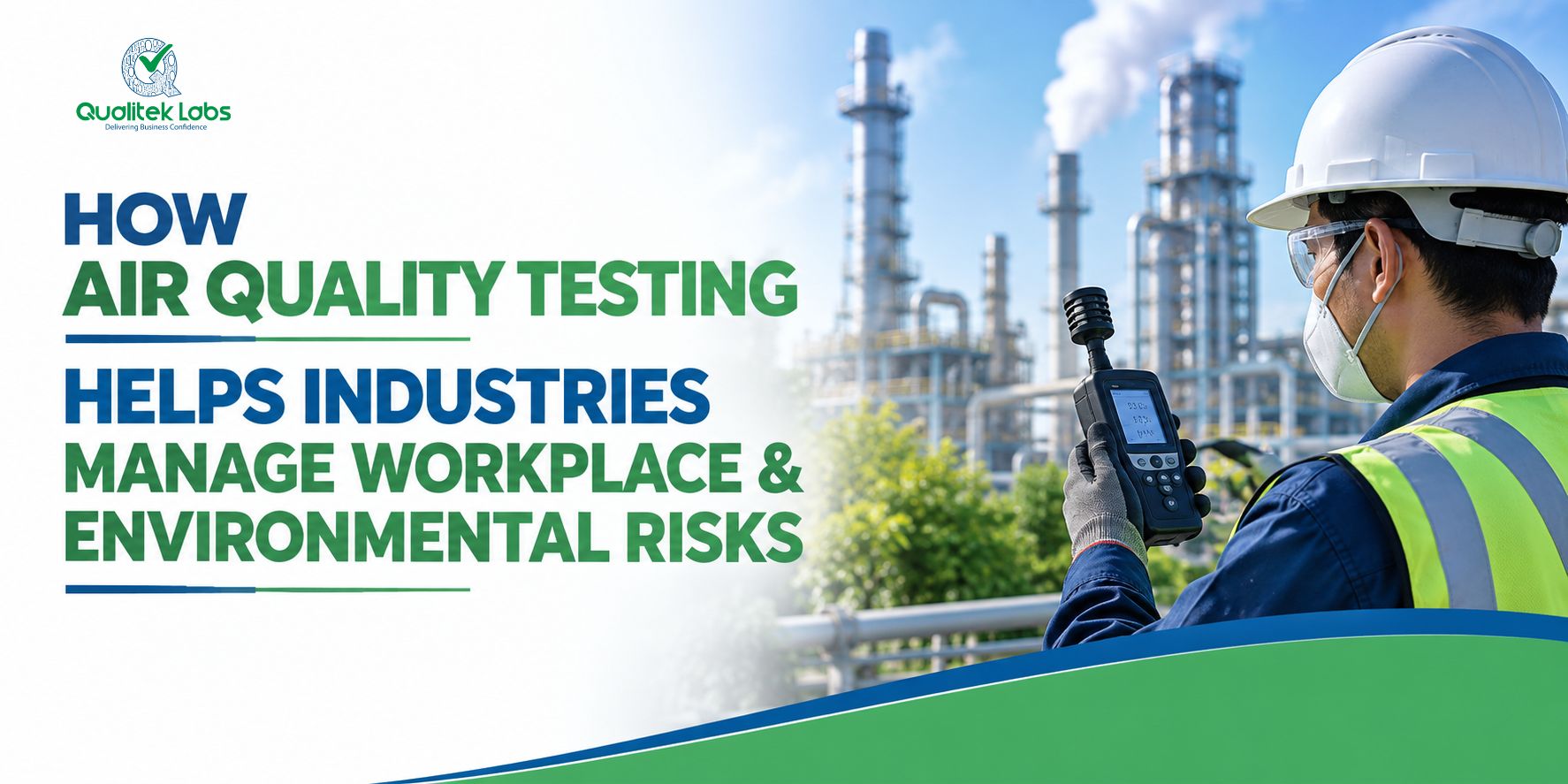
Air is easy to overlook in an industrial setting because you cannot always see what is present in it. Dust, gases, fumes and volatile compounds can build up around production areas or escape through industrial stacks without creating an obvious warning. By the time poor air quality becomes noticeable, workers, nearby communities and the environment may already be exposed.
This is why air quality testing is an important part of industrial environmental monitoring. It gives manufacturers measurable data about pollutants in workplace and surrounding air, helping them identify potential risks, evaluate controls and demonstrate compliance with applicable requirements.
In India, ambient air quality monitoring includes parameters such as particulate matter, sulphur dioxide (SO₂), nitrogen dioxide (NO₂), carbon monoxide, ozone, ammonia and other pollutants under the National Ambient Air Quality Standards framework.
What Is Air Quality Testing?
Air quality testing involves collecting and analysing air samples to determine the concentration of specific pollutants in a particular environment. The parameters tested depend on the location, industrial activity, potential sources of pollution and the purpose of the assessment.
For industries, testing may include ambient air quality monitoring around a facility as well as stack emission monitoring, where emissions released through chimneys or stacks are assessed.
Common parameters can include particulate matter such as PM10 and PM2.5, sulphur dioxide, nitrogen dioxide, carbon monoxide and other industry-specific pollutants. Qualitek Labs lists both stack monitoring and ambient air quality testing among its environmental monitoring services.
Why Is Air Quality Testing Important for Industries?
Industrial facilities can generate air emissions from manufacturing processes, boilers, furnaces, combustion equipment, material handling and other operations. Testing helps turn these potential sources into measurable data.
1. Helps Identify Air Pollution Sources
One of the biggest advantages of regular monitoring is visibility.
A manufacturing unit may have multiple potential sources of emissions. Dust may originate from material handling, while combustion processes can release gases and particulate matter. Without testing, it can be difficult to determine whether existing pollution-control measures are working as intended.
Air monitoring provides data that can help environmental and EHS teams investigate unusual readings, identify trends and determine where corrective action may be required.
2. Supports Workplace Health and Safety
Poor indoor air quality can affect employees through exposure to pollutants and inadequate ventilation. According to the U.S. Occupational Safety and Health Administration (OSHA), poor indoor air quality has been associated with symptoms including headaches, fatigue, difficulty concentrating and irritation of the eyes, nose, throat and lungs.
For industrial workplaces, the potential contaminants depend heavily on the processes being carried out. Testing can therefore help organisations understand what workers may be exposed to and whether additional controls, ventilation improvements or process changes should be considered.
It is important to distinguish workplace exposure monitoring from ambient environmental monitoring: the appropriate parameters and assessment criteria depend on the specific workplace and applicable occupational requirements.
3. Helps Monitor Environmental Emissions
Industrial emissions do not stop at the factory boundary. Pollutants released into the atmosphere can affect surrounding areas depending on their concentration, source and environmental conditions.
Ambient air monitoring helps industries understand air quality around their facilities. India’s national monitoring framework includes pollutants such as PM10, PM2.5, SO₂ and NO₂, along with other notified parameters.
Regular monitoring can therefore support a more complete picture of how industrial activity may be affecting the surrounding environment.
4. Supports Regulatory Compliance
Environmental compliance is a major reason industries conduct air and emission monitoring.
Depending on the facility and its applicable consent conditions, industries may need to monitor specific emissions and environmental parameters. Regulatory authorities such as the Central Pollution Control Board (CPCB) and State Pollution Control Boards play important roles in India’s environmental monitoring framework.
Testing data can help businesses demonstrate that their monitoring and pollution-control programmes are based on measurable results rather than assumptions. Qualitek Labs notes that its environmental monitoring services include compliance monitoring covering air, water and waste emissions.
5. Helps Evaluate Pollution-Control Measures
Installing a pollution-control system is only part of the solution. Industries also need to understand whether those controls are performing effectively.
Periodic air quality testing can help compare results over time and identify changes in emission patterns. If pollutant levels increase unexpectedly, the data can prompt an investigation into equipment performance, maintenance, raw materials or production processes.
This makes monitoring useful not just for compliance, but also for ongoing environmental management.
Air Quality Testing: Ambient Air vs Stack Monitoring
These two forms of testing are related but serve different purposes.
Ambient Air Quality Testing
Ambient air quality testing evaluates pollutant concentrations in the surrounding or open environment. It can help industries understand the quality of air around a facility.
Stack Monitoring
Stack monitoring, on the other hand, focuses on emissions released from a specific industrial source such as a chimney, stack or exhaust outlet. Qualitek Labs specifically provides stack monitoring for industrial emissions, including particulate matter such as PM10 and PM2.5.
Using the appropriate monitoring approach is important because a single test cannot provide a complete picture of every potential emission source.
How Can Industries Improve Air Quality Management?
Testing works best when it is part of a broader environmental management programme. Industries can use monitoring results to identify recurring problems, review pollution-control systems, improve ventilation where necessary and investigate unusual readings.
The testing frequency and parameters should be determined according to the facility’s processes, applicable regulations, consent conditions and potential pollutants.
Working with a competent environmental testing laboratory also helps ensure that sampling and analysis are carried out using appropriate methods and that the resulting data can support environmental decision-making.
Why Choose a Professional Air Quality Testing Laboratory?
Reliable results depend on more than simply placing a monitoring instrument at a site. Sampling, sample handling, analytical methods, quality control and reporting all influence the usefulness of the final results.
Qualitek Labs is a NABL ISO/IEC 17025:2017 accredited laboratory and offers environmental monitoring services covering air, water, soil, emissions and other environmental parameters. Its air testing services include ambient air quality testing and stack monitoring.
For manufacturers, partnering with an experienced testing laboratory can make environmental monitoring more systematic and help convert test results into useful compliance and risk-management information.
Conclusion
Air quality is both an environmental and workplace concern for industries. From particulate matter and industrial emissions to gases and other pollutants, the risks can vary significantly depending on the manufacturing process.
Air quality testing provides the data industries need to understand these risks. It can help identify pollution sources, support workplace health programmes, evaluate emission-control measures and demonstrate compliance with applicable environmental requirements.
For manufacturers, regular and properly planned monitoring is therefore more than a regulatory exercise. It is a practical way to make environmental performance measurable and to address potential risks before they become larger operational or compliance problems.
With its environmental monitoring capabilities and NABL ISO/IEC 17025:2017 accreditation, Qualitek Labs supports industries with testing services designed to generate reliable environmental data for informed decision-making.
Frequently Asked Questions
1. What is air quality testing?
Air quality testing is the process of collecting and analysing air samples to measure specified pollutants in a workplace, industrial facility or surrounding environment.
2. What parameters are tested during air quality testing?
Depending on the purpose of testing, parameters may include PM10, PM2.5, sulphur dioxide, nitrogen dioxide, carbon monoxide, ozone, ammonia and other pollutants relevant to the facility or applicable standards.
3. What is the difference between ambient air testing and stack monitoring?
Ambient air testing evaluates pollutant concentrations in the surrounding environment, while stack monitoring assesses emissions released from a specific industrial source such as a chimney or exhaust stack.
4. How does air quality testing help manufacturers?
It can help manufacturers identify pollution sources, evaluate control measures, monitor environmental conditions, support compliance activities and investigate potential workplace or environmental risks.
5. How often should industries conduct air quality testing?
There is no single frequency that applies to every industry. Testing requirements depend on the facility, applicable regulations, consent conditions, processes and pollutants involved. Industries should follow the monitoring schedule and parameters applicable to their operations.