

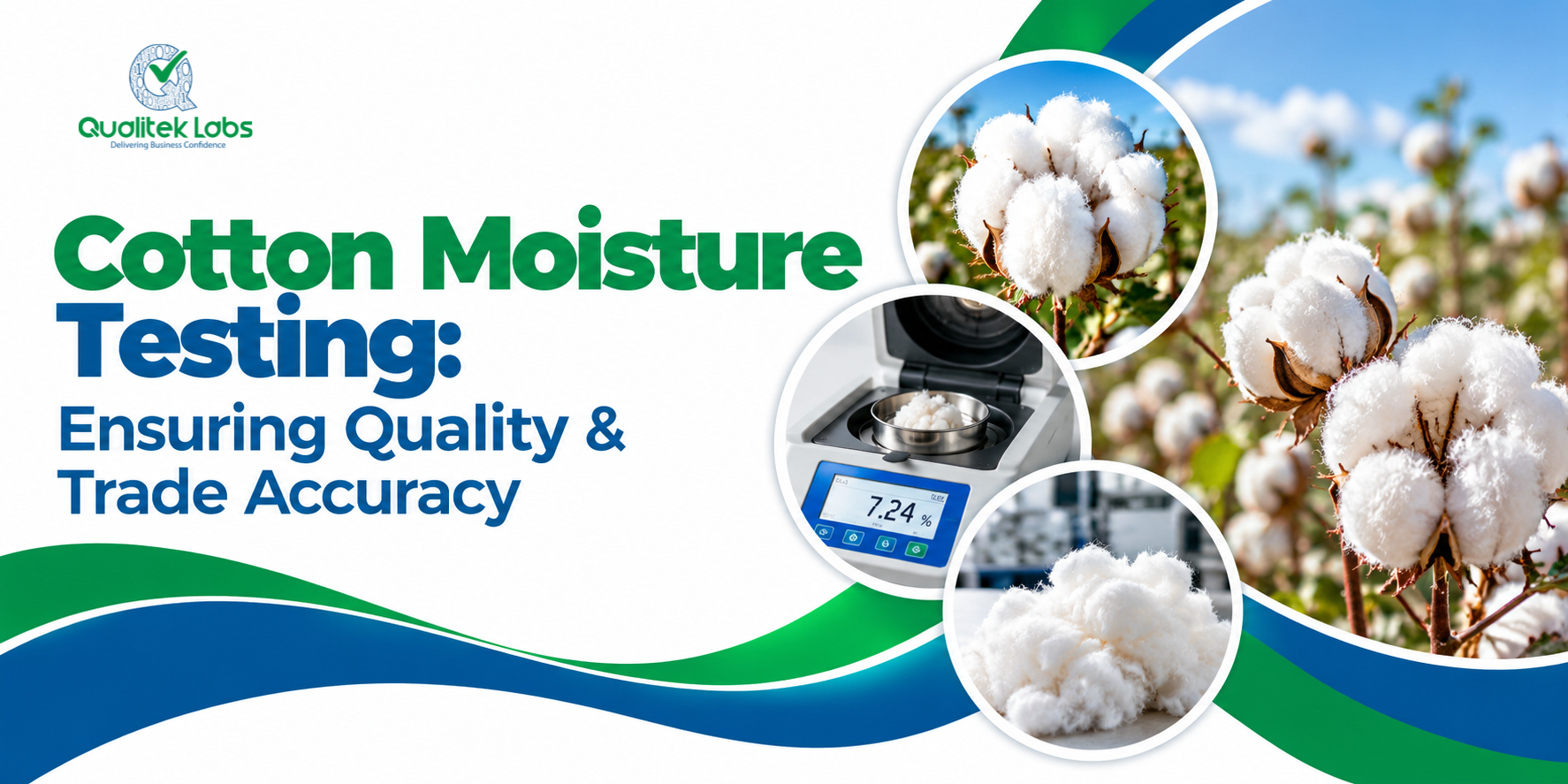
Cotton is one of the most important natural fibres used in the textile industry. From spinning and weaving to garment manufacturing and export, cotton quality plays a significant role in determining the performance, value, and usability of textile products. However, cotton quality is influenced by several factors, including fibre length, strength, colour, cleanliness, and moisture content.
Among these parameters, moisture content deserves particular attention because it directly affects cotton weight, storage conditions, fibre processing, and commercial transactions. Excessive moisture can create discrepancies in bale weight, increase the risk of deterioration during storage, and affect the efficiency of textile manufacturing operations. Conversely, cotton that is too dry may generate more static electricity and fibre breakage during processing.
Cotton moisture testing helps buyers, traders, warehouse operators, and textile manufacturers assess the moisture condition of cotton bales before storage, processing, or dispatch. It supports more transparent transactions by providing measurable information about moisture levels and helping stakeholders make informed decisions.
Working with a reliable cotton testing lab can make this process more systematic. Professional testing and inspection services help businesses assess cotton quality, document observations, and reduce avoidable risks throughout the supply chain.
In this article, we explore why cotton moisture testing is important, how it works, the benefits it offers, and how businesses can select a suitable testing partner.
What Is Cotton Moisture Testing?
Cotton moisture testing is the process of measuring the amount of moisture present in cotton fibres. Moisture content is generally expressed as a percentage, calculated according to the measurement method and reporting convention used.
Cotton naturally absorbs moisture from the surrounding environment. Its moisture condition can change depending on temperature, relative humidity, storage duration, ventilation, packaging, and transportation conditions.
Because moisture influences the weight and behaviour of cotton, it is important to measure it using an appropriate method rather than relying only on visual inspection or touch.
A professional Cotton Testing Laboratory may use calibrated moisture meters or other suitable analytical methods to assess moisture content. The testing approach depends on the purpose of the inspection, the applicable specification, and the level of accuracy required.
For cotton traders and buyers handling large consignments, moisture measurements provide useful evidence when evaluating the condition of a lot. When combined with bale inspection, representative sampling, and other fibre-quality assessments, moisture testing contributes to a more comprehensive quality control programme.
Why Is Cotton Moisture Testing Important?
Moisture testing is not simply a routine inspection activity. It helps businesses manage several quality, storage, processing, and commercial risks.
1. Accurate Cotton Weight Assessment
Cotton is commonly bought and sold in bulk, with transactions based on bale weight, lot quantity, grade, and other contractual specifications.
Since moisture contributes to the measured weight of cotton, unusually high moisture levels can affect the commercial interpretation of a shipment. If moisture conditions differ significantly between lots, buyers may need additional information to compare their quality and weight consistently.
Moisture testing helps buyers and sellers understand the moisture condition of a consignment and identify potential discrepancies that require investigation.
For example, if a buyer receives cotton with a higher-than-expected moisture reading, the parties can review the inspection records, contractual moisture requirements, weighing procedures, and storage conditions before reaching a conclusion.
A documented testing process can therefore support fairer trade practices and reduce misunderstandings about cotton bale weight.
2. Prevention of Storage-Related Damage
Cotton bales are often stored in warehouses before they are transported to spinning mills or other processing facilities. If cotton contains excessive moisture and is stored under unsuitable conditions, the risk of deterioration may increase.
Depending on the moisture level, temperature, ventilation, and duration of storage, excessive moisture can contribute to microbial growth, musty odours, discolouration, and damage to fibre quality.
Such problems can create additional costs through material rejection, handling, cleaning, or quality investigations.
Regular moisture checks help warehouse operators identify potentially problematic bales and investigate whether corrective measures are necessary. Good storage practices, including protection from rain, leaks, damp flooring, and condensation, remain essential.
A reliable cotton testing lab can support these preventive measures by providing documented readings and observations during warehouse inspections.
3. Better Fibre Processing Performance
Cotton moisture affects how fibres behave during spinning and other textile manufacturing operations.
Cotton that is excessively dry may be more susceptible to static electricity, fibre fly, and breakage under certain processing conditions. These issues can affect machine efficiency, yarn quality, and production consistency.
On the other hand, excessive moisture can create processing difficulties and may encourage deterioration if the cotton is stored improperly.
Maintaining moisture within an appropriate range helps manufacturers manage processing conditions more effectively. The ideal range depends on the cotton, process, equipment, and applicable manufacturing specifications.
A Cotton Fiber Testing Laboratory can assess moisture alongside other relevant fibre characteristics, allowing manufacturers to consider the overall condition of the material rather than relying on a single measurement.
4. Improved Quality Control and Consistency
Cotton quality can vary between bales, even within the same shipment. Differences may result from growing conditions, harvesting practices, ginning, storage, and transportation.
Moisture testing provides a measurable quality parameter that can be compared across selected bales and production lots.
For example, testing several randomly selected bales from a consignment can help reveal whether moisture readings are reasonably consistent or whether certain bales require further investigation.
A structured quality control procedure should define the sampling plan, measurement locations, recording method, acceptance criteria, and action to take when results fall outside the specified range.
When moisture testing is combined with fibre grading and other quality assessments, businesses can make better-informed decisions about acceptance, storage, and processing.
5. Reduced Commercial Disputes
Disputes can arise when cotton buyers and sellers disagree about moisture levels, weight, bale condition, or compliance with purchase specifications.
Without reliable inspection records, it can be difficult to establish what was observed before loading or delivery.
Cotton Inspection & Testing helps address this challenge by creating a documented record of the consignment’s condition. Depending on the agreed scope, records may include bale counts, bale markings, moisture readings, sampling details, physical observations, and inspection dates.
These records can help buyers, traders, and suppliers investigate discrepancies and resolve issues more efficiently.
For best results, the parties should agree in advance on the testing method, sampling procedure, acceptable moisture range, and how results will be interpreted.
Looking for Reliable Cotton Moisture Testing Services?
Ensure cotton quality, accurate moisture assessment, and transparent trade with Qualitek Labs’ cotton testing and inspection services for traders, textile manufacturers, buyers, and exporters.
How Is Cotton Moisture Testing Performed?
The testing procedure depends on the type of cotton, inspection requirements, equipment, and contractual specifications. A typical field-based process may include the following steps.
Step 1: Lot Verification
The inspector verifies the lot identification, bale count, bale markings, and available documentation. This ensures that the testing records relate to the correct consignment.
Step 2: Representative Bale Selection
Selected bales are chosen according to an agreed sampling plan. Random selection helps reduce the risk of testing only those bales that appear to be in better condition.
The number of bales tested depends on the lot size, sampling protocol, contractual requirements, and the level of confidence required.
Step 3: Moisture Meter Preparation
The moisture meter is checked and operated according to the manufacturer’s instructions. Where applicable, the equipment’s calibration or verification status is reviewed before measurements begin.
Correct instrument handling is important because equipment condition, measurement technique, and environmental factors can influence results.
Step 4: Moisture Measurement
Readings are taken at appropriate locations on the selected bales. Multiple measurements may be required to account for variation within a bale.
The inspector follows the specified procedure for probe placement, contact, measurement depth, and recording.
Step 5: Recording and Calculation
The readings are documented against the relevant bale or lot identification. If required by the inspection protocol, the average moisture reading is calculated.
Averages should be interpreted carefully because they may conceal unusually high readings in individual bales. Individual results and any outliers should be reviewed against the applicable acceptance criteria.
Step 6: Reporting
The inspector prepares a moisture report or inspection slip containing the relevant lot details, sampling information, measurements, observations, and findings.
The report is shared with the concerned buyer, seller, or trader to support quality decisions and maintain traceability.
A professional provider offering cotton testing services can help businesses standardise these steps across multiple warehouses and consignments.
Factors That Affect Cotton Moisture Readings
Accurate moisture testing requires an understanding of the conditions that can influence measurements.
- Ambient humidity: Cotton absorbs moisture from the surrounding air, so environmental conditions can affect readings.
- Storage conditions: Poor ventilation, water leakage, damp flooring, and condensation may contribute to uneven moisture distribution.
- Sampling location: Moisture may vary within a bale, making measurement location important.
- Instrument condition: Calibration, maintenance, and correct operation help improve measurement reliability.
- Measurement technique: Probe contact, insertion depth, and the number of readings can affect results.
- Transportation exposure: Rain, wet loading areas, and unsuitable vehicle conditions may affect cotton during dispatch.
A reliable analytical testing lab follows documented procedures to minimise avoidable variation and ensure that results are interpreted appropriately.
Cotton Moisture Testing and Other Fibre Quality Assessments
Moisture testing is an important part of cotton quality control, but it does not provide a complete picture of fibre quality on its own.
Other assessments may be needed depending on the product, intended application, and buyer requirements.
High Volume Instrument (HVI) Testing
HVI testing measures important cotton fibre properties such as fibre length, strength, micronaire, and colour. Depending on the equipment and configuration, additional parameters may also be assessed.
These measurements help buyers and textile manufacturers evaluate cotton for specific processing and end-use requirements.
Manual Cotton Classing
Manual classing involves the visual and tactile assessment of cotton characteristics by a trained classer. Depending on the agreed procedure, it may include colour, leaf or trash content, visible contamination, and an assessment of staple length.
Lot Supervision and Bale Inspection
Physical inspection helps verify bale counts, markings, packing condition, and lot identity. It can also identify visible damage or signs of improper storage.
Representative Sampling
Sampling provides material for further laboratory analysis. A suitable sampling plan helps ensure that the collected specimens reasonably represent the lot being evaluated.
Together, these procedures form a more comprehensive approach to cotton quality assessment. An experienced analytical testing laboratory can help coordinate suitable tests according to the requirements of the buyer or manufacturer.
How to Choose the Right Cotton Testing Laboratory
Selecting a suitable testing partner is important for cotton traders, textile manufacturers, warehouse operators, and exporters.
When evaluating a cotton testing lab in India, consider the following factors.
1. Relevant Testing Experience
Choose a laboratory or inspection provider with experience in cotton moisture measurement, bale inspection, sampling, and related fibre-quality assessments.
2. Appropriate Equipment and Procedures
Ask about the instruments used, maintenance practices, measurement procedures, and the method followed to document results.
3. Reliable Reporting
Reports should clearly identify the lot, sampled bales, measurements, observations, and applicable acceptance criteria. Clear reporting makes it easier to review findings and compare consignments.
4. Appropriate Accreditation and Scope
If accredited testing is required, verify the provider’s current accreditation status and whether the specific test and method fall within its accredited scope.
A provider may offer both inspection and testing activities, but not every service is necessarily accredited. Confirm the status of each relevant service before placing an order.
5. Inspection and Logistics Support
Businesses managing large consignments may also need lot supervision, hook sampling, manual classing, dispatch supervision, HVI coordination, and sample courier arrangements.
An experienced inspection company can help coordinate these activities, reduce communication gaps, and make the overall process more efficient.
When searching for a Cotton testing lab near me, consider not only proximity but also service coverage, reporting quality, turnaround time, and the provider’s ability to support your operational requirements.
The Role of Analytical Testing Services in Cotton Quality Management
Analytical testing services support businesses by converting physical samples and measurements into documented information that can be used for quality decisions.
In cotton trading, this information may help buyers assess whether a lot meets purchase specifications, determine whether further testing is necessary, and investigate differences between consignments.
A capable analytical lab should apply suitable measurement methods, maintain appropriate equipment, document sample identification, and communicate the limitations of its results.
For businesses that require a broader range of textile-related assessments, working with an analytical testing laboratory that can coordinate relevant testing and inspection activities may simplify quality management.
However, moisture results should always be interpreted within the context of the applicable measurement method, sampling plan, and contractual requirements. No single reading can guarantee the condition of every bale in a large consignment.
Benefits of Professional Cotton Testing Services
Professional cotton testing services offer several practical benefits to businesses involved in the cotton supply chain.
- Improved transparency: Documented readings help buyers and sellers understand the moisture condition of a consignment.
- Better inventory management: Moisture observations can help identify bales that may require additional inspection or improved storage conditions.
- More consistent quality decisions: Standardised procedures make it easier to compare consignments and investigate variations.
- Reduced operational risk: Early identification of potential moisture problems can help prevent avoidable storage and processing issues.
- Stronger traceability: Reports and sampling records provide useful documentation for internal quality control and commercial discussions.
- Better coordination: Integrated testing, inspection, and reporting can simplify communication between warehouses, traders, laboratories, and buyers.
These benefits are especially valuable when businesses handle large quantities of cotton across multiple locations.
Conclusion: Choose Qualitek Labs for Reliable Cotton Testing Services
Cotton moisture testing is an essential part of quality control and transparent cotton trading. By measuring and documenting moisture levels, businesses can make better-informed decisions about bale acceptance, storage, transportation, and processing.
A structured testing process helps identify unusual readings, improve traceability, support commercial discussions, and reduce avoidable quality risks. When combined with representative sampling, lot supervision, manual classing, and HVI testing, moisture assessment contributes to a more complete understanding of cotton quality.
Qualitek Labs offers cotton testing and inspection solutions designed to support traders, textile manufacturers, buyers, and exporters. Its service portfolio includes moisture checking, lot supervision and hook sampling, manual cotton classing, representative sampling, dispatch supervision, HVI testing coordination, and sample courier support.
If your business needs a dependable partner for cotton quality assessment, contact Qualitek Labs to discuss your requirements. With a structured approach to testing, inspection, and reporting, Qualitek Labs can help you improve quality control, strengthen trade transparency, and make more informed decisions throughout the cotton supply chain.
Frequently Asked Questions (FAQs)
1. Why is moisture testing important in cotton?
Moisture testing helps assess cotton’s moisture condition, supports more consistent weight and quality evaluations, and helps identify potential storage or processing risks. It also provides useful documentation for commercial transactions.
2. How is moisture content measured in cotton bales?
Moisture content can be measured using a suitable moisture meter or an appropriate laboratory method. The inspector follows the specified procedure, takes readings from selected bales, records the results, and evaluates them against the applicable requirements.
3. How many cotton bales should be tested for moisture?
The number depends on the total lot size, the agreed sampling plan, the buyer’s requirements, and the purpose of the inspection. Testing multiple randomly selected bales can provide a more representative picture than relying on a single bale.
4. Can excessive moisture affect cotton quality?
Yes. Depending on the conditions, excessive moisture can contribute to storage deterioration, microbial growth, odours, and processing difficulties. It may also affect the interpretation of bale weight during commercial transactions.
5. How do I choose a reliable cotton testing lab in India?
Look for relevant testing experience, suitable equipment, documented procedures, clear reporting, and appropriate service coverage. If accredited testing is required, verify the provider’s current accreditation scope for the specific test you need.