

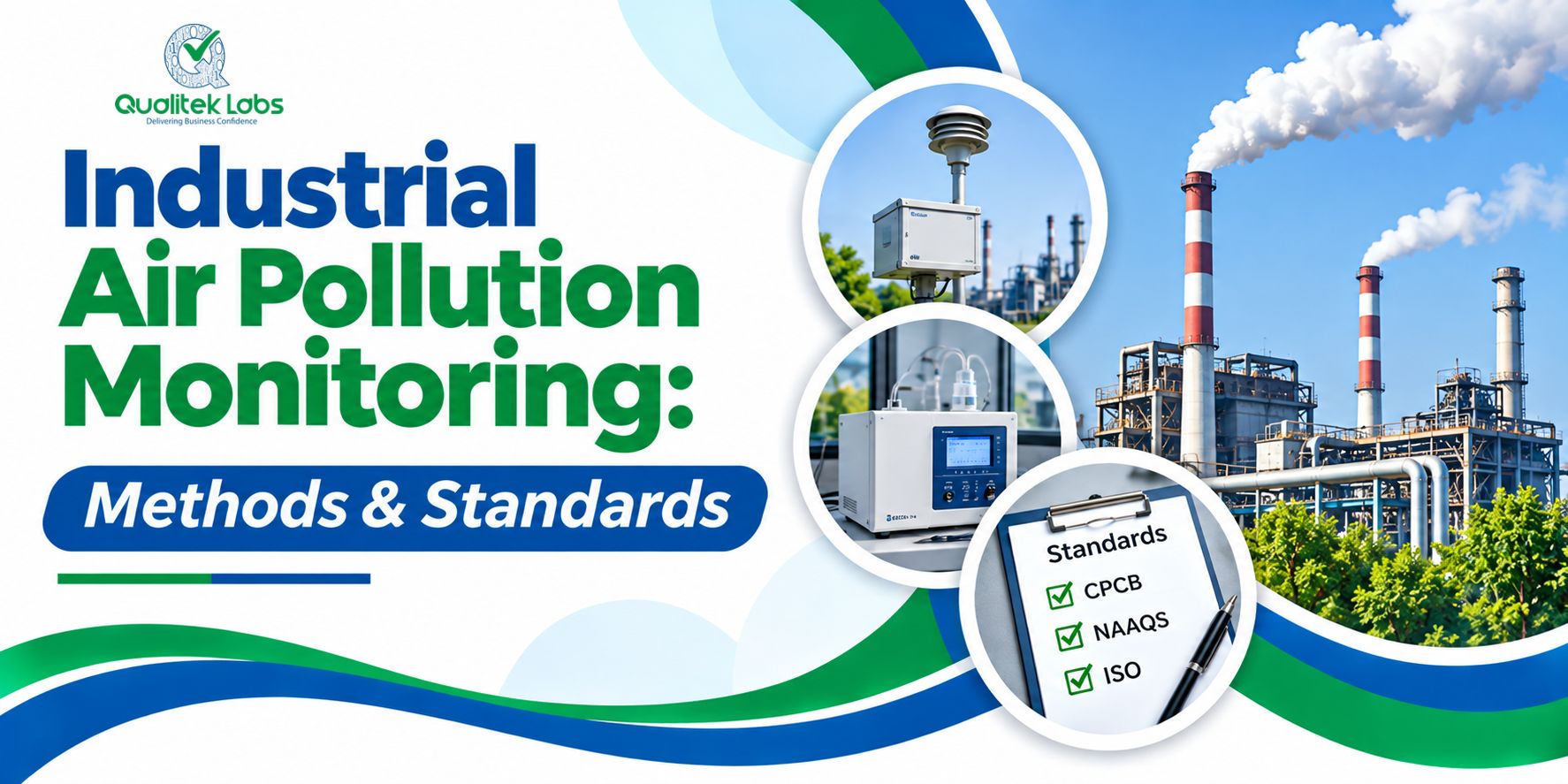
Industrialisation has contributed significantly to economic growth, infrastructure development, and employment opportunities. However, increasing industrial activities have also resulted in rising levels of air pollution. Emissions from manufacturing units, power plants, chemical industries, and other industrial facilities release pollutants that can negatively affect human health, environmental quality, and ecological balance.
This makes industrial air pollution monitoring an essential requirement for businesses looking to maintain environmental safety and comply with regulatory standards. Regular air quality assessments help industries identify harmful pollutants, evaluate emission levels, and implement effective pollution control measures.
Through professional environmental monitoring services, industries can ensure that their operations meet prescribed environmental requirements while contributing to a cleaner and healthier environment.
What Is Industrial Air Pollution Monitoring?
Industrial air pollution monitoring is the systematic process of measuring, analysing, and evaluating pollutants released into the atmosphere through industrial activities.
It involves assessing emissions from industrial chimneys, monitoring surrounding air quality, and identifying pollutants that may pose risks to human health and the environment.
Professional industrial air pollution testing helps organisations understand their emission levels and determine whether they comply with applicable environmental regulations.
Some commonly monitored air pollutants include:
- Particulate Matter (PM10 and PM2.5)
- Sulphur Dioxide (SO₂)
- Nitrogen Oxides (NOx)
- Carbon Monoxide (CO)
- Carbon Dioxide (CO₂)
- Volatile Organic Compounds (VOCs)
- Other industry-specific gaseous pollutants
Regular air quality testing provides industries with valuable information about pollution levels and helps them take appropriate corrective measures.
Why Is Industrial Air Pollution Monitoring Important?
Air pollution can have serious consequences for employees, nearby communities, and the surrounding ecosystem. Industrial facilities must therefore adopt appropriate pollution monitoring practices to minimise environmental risks.
Here are some important reasons why industrial air pollution monitoring is necessary:
1. Ensures Regulatory Compliance
Industries must follow applicable environmental regulations and emission limits established by regulatory authorities. Regular environmental compliance testing helps businesses evaluate their emissions and maintain compliance with prescribed standards.
2. Protects Human Health
Exposure to harmful air pollutants can contribute to respiratory problems, cardiovascular diseases, and other health complications. Consistent air quality monitoring helps identify potential exposure risks and supports preventive action.
3. Reduces Environmental Pollution
Monitoring industrial emissions helps identify pollution sources and evaluate the effectiveness of pollution control equipment. This supports better environmental management and reduces the release of harmful substances into the atmosphere.
4. Improves Industrial Operations
Regular emission assessments help industries identify inefficiencies in their production processes and pollution control systems. This allows organisations to take timely corrective measures.
5. Supports Sustainable Industrial Development
Responsible environmental management helps businesses reduce their environmental footprint and contribute to sustainable industrial development.
Major Methods of Industrial Air Pollution Monitoring
Different monitoring techniques are used to assess air pollution depending on the source of emissions, type of pollutants, and purpose of testing.
The following are some commonly used methods in industrial air pollution monitoring.
1. Stack Emission Monitoring
Stack emission monitoring is one of the most important components of industrial air pollution testing. It involves measuring pollutants released through industrial chimneys and exhaust stacks.
Industries such as cement manufacturing, power generation, chemical processing, and metal production commonly require stack emission assessments.
During stack monitoring, trained professionals collect and analyse emission samples to determine the concentration of pollutants.
The testing process may include:
- Particulate Matter (PM10 and PM2.5) assessment
- Sulphur dioxide measurement
- Nitrogen oxide analysis
- Carbon monoxide monitoring
- Other industry-specific emission parameters
Stack emission monitoring services help industries assess the performance of pollution control equipment and verify whether emissions comply with applicable standards.
2. Ambient Air Quality Monitoring
Ambient air quality monitoring involves measuring pollutant concentrations in the surrounding outdoor environment.
Unlike stack monitoring, which evaluates emissions from a specific industrial source, ambient air monitoring assesses the quality of air in open spaces, industrial premises, and surrounding areas.
The common parameters evaluated include:
- PM10 and PM2.5
- Sulphur dioxide (SO₂)
- Nitrogen dioxide (NO₂)
- Carbon monoxide (CO)
- Other relevant gaseous pollutants
Ambient air quality testing helps industries understand the impact of their operations on the surrounding environment.
It is particularly important for industrial estates, manufacturing facilities, construction projects, and areas with significant industrial activity.
3. Particulate Matter Monitoring
Particulate matter consists of tiny solid particles and liquid droplets suspended in the air.
PM10 refers to particles with an aerodynamic diameter of up to 10 micrometres, while PM2.5 refers to finer particles with an aerodynamic diameter of up to 2.5 micrometres.
These particles can enter the respiratory system and cause health-related concerns.
Regular PM10 and PM2.5 testing helps industries assess particulate pollution and evaluate the effectiveness of dust collection and filtration systems.
4. Gaseous Pollutant Monitoring
Industrial processes may release different gaseous pollutants depending on the materials used and the nature of production.
Monitoring gases such as sulphur dioxide, nitrogen oxides, carbon monoxide, and volatile organic compounds helps identify potential environmental hazards.
These assessments support effective emission management and help industries maintain applicable air quality requirements.
Important Standards and Regulations for Industrial Air Pollution Monitoring in India
In India, industrial air pollution is regulated through environmental legislation and standards established by the relevant authorities.
The Air (Prevention and Control of Pollution) Act, 1981, provides the legislative framework for preventing, controlling, and reducing air pollution.
The Environment (Protection) Act, 1986, also provides an important framework for environmental protection and the establishment of pollution control standards.
Some important regulatory frameworks and guidelines include:
1. Air (Prevention and Control of Pollution) Act, 1981
This Act aims to prevent, control, and reduce air pollution in India. It empowers pollution control authorities to regulate industrial emissions and take necessary measures to maintain air quality.
2. Environment (Protection) Act, 1986
The Environment (Protection) Act provides a broader framework for environmental protection. Standards and rules notified under this Act help regulate industrial emissions and environmental pollutants.
3. National Ambient Air Quality Standards (NAAQS), 2009
The Central Pollution Control Board (CPCB) established National Ambient Air Quality Standards to define acceptable pollutant concentrations in ambient air.
These standards cover parameters such as PM10, PM2.5, sulphur dioxide, nitrogen dioxide, carbon monoxide, ozone, and other pollutants.
4. CPCB and State Pollution Control Board Guidelines
The Central Pollution Control Board (CPCB) and State Pollution Control Boards (SPCBs) play an important role in monitoring and controlling industrial air pollution.
Industries must follow applicable emission limits, monitoring requirements, consent conditions, and other directions issued by the relevant authorities.
Note: Applicable emission limits and monitoring requirements vary according to industry category, manufacturing process, fuel type, and regulatory conditions. Industries should refer to the latest notifications and applicable directions issued by the concerned authorities.
Steps Involved in Industrial Air Quality Testing
A systematic approach is essential to obtain reliable results during industrial air quality testing.
The typical testing process involves the following steps:
- Understanding Testing Requirements: The testing laboratory identifies the industrial activity, pollution sources, applicable standards, and parameters that need to be evaluated.
- Site Inspection: The testing team assesses the industrial premises and identifies suitable sampling locations.
- Sample Collection: Air and emission samples are collected using appropriate sampling equipment and established testing procedures.
- Laboratory Analysis: Collected samples are analysed using suitable analytical instruments and validated testing methods.
- Result Evaluation: The obtained results are compared with applicable regulatory standards and permissible limits.
- Report Preparation: A detailed testing report is prepared to present the findings and relevant observations.
Regular testing allows industries to identify potential environmental concerns and take corrective action when necessary.
How to Choose the Right Environmental Testing Laboratory?
Selecting a reliable environmental testing laboratory is important for obtaining accurate results and maintaining regulatory compliance.
Businesses should consider the following factors when choosing an environmental testing partner:
- Technical Expertise: Choose a laboratory with experienced scientists and qualified technical professionals.
- Modern Equipment: Ensure the laboratory uses appropriate instruments for accurate air quality testing and emission analysis.
- Applicable Standards: Verify that testing is performed using relevant CPCB, BIS, ISO, and other applicable methods.
- Laboratory Accreditation: Check whether the laboratory has the relevant NABL accreditation and whether the required testing parameters are included within its accredited scope.
- Reliable Reporting: Choose a laboratory that provides clear, accurate, and timely testing reports.
- Comprehensive Services: A laboratory offering stack emission monitoring, ambient air quality testing, and other environmental testing services can support multiple industrial requirements.
Partnering with an experienced environmental testing laboratory helps organisations make informed decisions about pollution control and environmental management.
Benefits of Professional Industrial Air Pollution Monitoring Services
Professional environmental testing services play an important role in helping industries maintain air quality and meet environmental responsibilities.
Some major benefits include:
- Accurate identification and measurement of industrial air pollutants.
- Better understanding of stack emissions and ambient air quality.
- Evaluation of industrial pollution control equipment.
- Support for environmental compliance and documentation.
- Identification of potential pollution risks.
- Improved environmental performance and sustainable business practices.
By partnering with a qualified environmental testing laboratory in India, industries can ensure that their air pollution monitoring requirements are addressed through appropriate testing procedures and reliable analytical reporting.
Frequently Asked Questions (FAQs)
1. What is industrial air pollution monitoring?
Industrial air pollution monitoring is the process of measuring and analysing pollutants released from industrial facilities. It helps identify harmful emissions, evaluate air quality, and ensure compliance with applicable environmental standards.
2. What are the major methods of industrial air quality testing?
The major methods include stack emission monitoring, ambient air quality monitoring, particulate matter testing, and gaseous pollutant analysis. The appropriate method depends on the industrial activity and testing requirements.
3. What pollutants are monitored during industrial air pollution testing?
Commonly monitored pollutants include PM10, PM2.5, sulphur dioxide (SO₂), nitrogen oxides (NOx), carbon monoxide (CO), and volatile organic compounds (VOCs). The exact parameters depend on the industry and its emission sources.
4. Which environmental standards regulate industrial air pollution in India?
Industrial air pollution is regulated under the Air (Prevention and Control of Pollution) Act, 1981, and the Environment (Protection) Act, 1986. Industries must also follow applicable CPCB guidelines, National Ambient Air Quality Standards (NAAQS), and industry-specific emission limits.
5. How often should industries conduct air quality monitoring?
The frequency depends on the industry category, applicable pollution control board requirements, consent conditions, and environmental clearance provisions. Industries should follow their specific regulatory monitoring schedules and conduct additional assessments whenever necessary.
Conclusion: Choose Qualitek Labs for Reliable Environmental Testing Services
Industrial air pollution monitoring is essential for protecting environmental quality, maintaining regulatory compliance, and promoting responsible industrial development. Regular stack emission monitoring and ambient air quality testing help businesses identify pollution sources, evaluate emission levels, and take effective measures to minimise environmental impact.
Choosing the right environmental testing partner is equally important for obtaining accurate results and making informed decisions.
Qualitek Labs offers comprehensive environmental monitoring and analytical testing services, including stack monitoring, ambient air quality testing, water testing, soil testing, noise testing, and other environmental assessments.
With experienced scientists, modern testing facilities, and a commitment to reliable analytical results, Qualitek Labs supports industries and organisations in meeting their environmental testing requirements.
If you are looking for a reliable environmental testing laboratory in India for industrial air quality testing and environmental compliance, partner with Qualitek Labs.
Together, let’s work towards cleaner air, safer industries, and a greener tomorrow.