

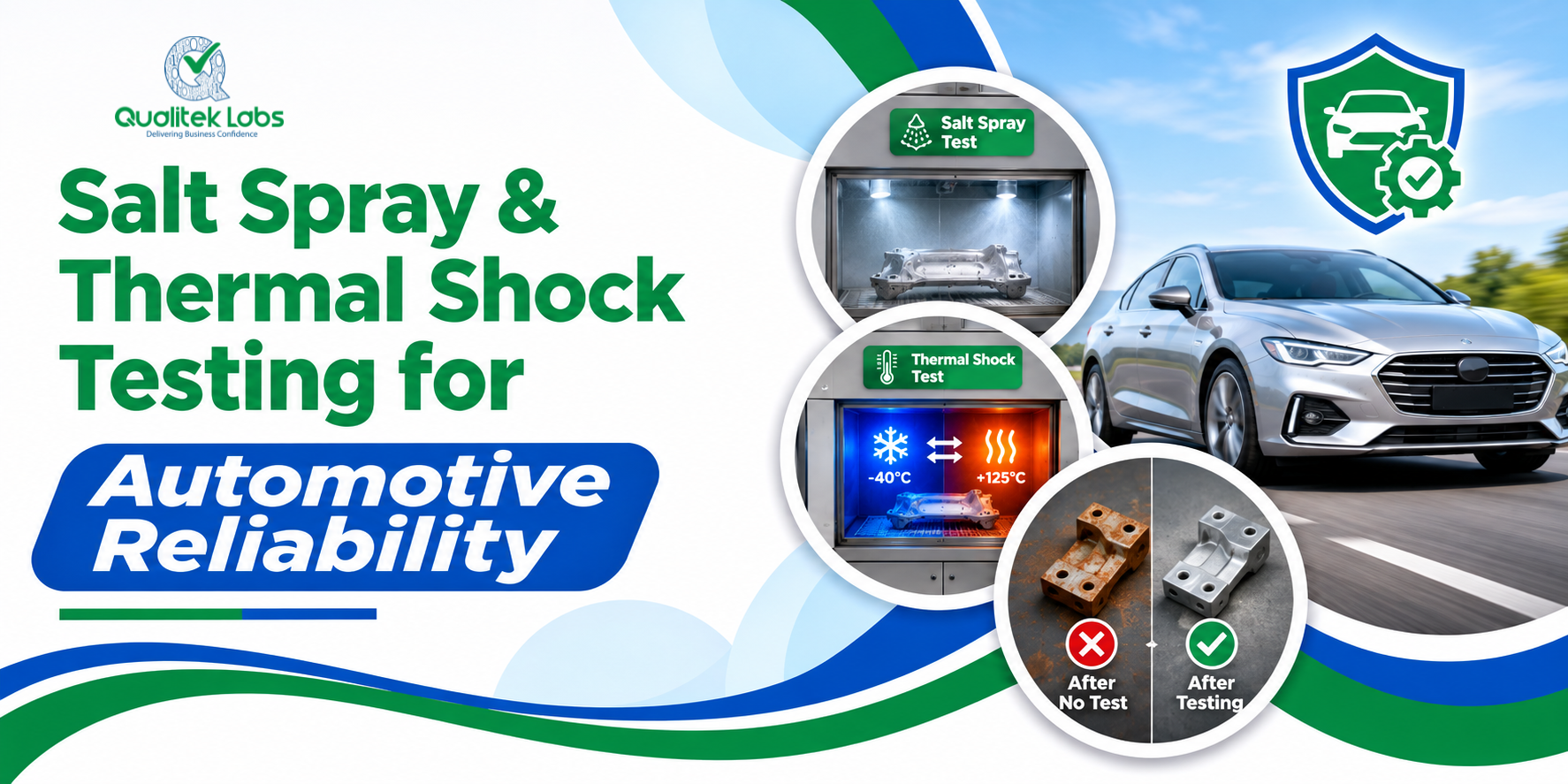
The automotive industry constantly faces challenges from changing environmental conditions, including extreme temperatures, moisture, humidity, road salt, and corrosive elements. Vehicle components must withstand these conditions throughout their service life while maintaining safety, functionality, and performance.
To ensure long-term durability, manufacturers rely on environmental testing methods such as Salt Spray Testing and Thermal Shock Testing. These tests help evaluate the resistance of automotive materials, coatings, and components against environmental stress and identify potential weaknesses before products reach the market.
From corrosion resistance to temperature durability, environmental testing plays a crucial role in improving automotive product quality and reliability.
Understanding Salt Spray Testing in the Automotive Industry
Salt Spray Testing is an accelerated corrosion testing method used to evaluate how metals, protective coatings, and surface finishes withstand corrosive environments.
Vehicles are frequently exposed to road salt, moisture, rain, and humid conditions. These environmental factors can cause rust, coating deterioration, and corrosion of critical automotive components.
During a salt spray test, samples are placed inside a controlled chamber where they are exposed to a fine mist of salt solution for a specified duration. After exposure, the samples are examined for corrosion, blistering, coating damage, and other signs of deterioration.
Common Types of Salt Spray Testing
- Neutral Salt Spray (NSS): Evaluates the corrosion resistance of metals and protective coatings under controlled neutral salt fog conditions.
- Copper-Accelerated Acetic Acid Salt Spray (CASS): Used to assess decorative and protective coatings under more aggressive acidic conditions.
- Acetic Acid Salt Spray (AASS): Evaluates corrosion resistance using an acidified salt solution.
- Synthetic Seawater Testing (SWAAT): Uses synthetic seawater exposure to assess the corrosion resistance of suitable materials and coatings, particularly in marine-related applications.
These testing methods help automotive manufacturers assess the performance of protective coatings, metal components, fasteners, brackets, and other corrosion-sensitive parts.
ISO 9227 specifies procedures for NSS, AASS, and CASS testing. The appropriate method and exposure duration depend on the product specification and applicable requirements.
Looking for Reliable Salt Spray and Thermal Shock Testing Services?
Ensure automotive component durability and reliability with advanced Salt Spray and Thermal Shock Testing Services from Qualitek Labs. Identify corrosion risks and temperature-related failures with confidence.
Get an Automotive Testing Quote
What Is Thermal Shock Testing?
Automotive components experience significant temperature variations during normal vehicle operation. For example, an engine compartment can become extremely hot, while external components may experience freezing temperatures during winter conditions.
Repeated exposure to sudden temperature changes can create thermal stress, resulting in cracks, material deformation, seal failure, and damage to electrical connections.
Thermal Shock Testing evaluates how materials and components respond when rapidly exposed to alternating high and low temperatures.
During a Thermal Shock Test, samples are transferred between environments with significantly different temperatures. This rapid temperature transition helps identify weaknesses that may not become visible during normal temperature cycling.
Types of Thermal Shock Testing
1. Air-to-Air Thermal Shock Testing
In this method, automotive components are exposed to alternating hot and cold air environments. It helps identify material weaknesses, cracking, and structural damage caused by sudden temperature variations.
2. Liquid-to-Liquid Thermal Shock Testing
This method involves rapidly transferring test samples between hot and cold liquid environments. It is useful for evaluating the thermal durability of materials and components designed for demanding operating conditions.
Both methods help manufacturers understand how their products respond to extreme thermal stress.
Importance of Thermal Shock Testing for Automotive Components
Automotive components are manufactured using different materials, including metals, plastics, rubber, glass, ceramics, and electronic assemblies. Each material responds differently to temperature changes.
Thermal Shock Testing for Automotive Components helps manufacturers identify potential failures before products are introduced into the market.
Some major applications include:
- Automotive Electronics: Evaluating circuit boards, sensors, connectors, and electronic control units for temperature-related failures.
- Plastic Components: Checking resistance to cracking, deformation, and dimensional changes.
- Rubber Seals and Gaskets: Assessing flexibility, sealing performance, and resistance to temperature extremes.
- Metal Components: Identifying cracks, structural weaknesses, and thermal stress.
- Battery Components: Evaluating suitable battery-related materials and assemblies under specified temperature transition conditions.
- Lighting Systems: Assessing the durability of automotive headlights, tail lamps, and associated assemblies.
Through Automotive Thermal Shock Testing, manufacturers can improve product reliability, minimize unexpected failures, and strengthen overall quality assurance.
How Salt Spray and Thermal Shock Testing Improve Automotive Reliability
Salt spray and thermal shock testing evaluate different environmental risks, but both contribute to automotive product durability.
Salt spray testing focuses on corrosion resistance, while thermal shock testing evaluates resistance to rapid temperature changes.
Together, these testing methods provide valuable information about how automotive components perform under challenging environmental conditions.
Key benefits include:
- Early Failure Detection: Identifies corrosion, cracks, coating damage, and material weaknesses.
- Improved Product Durability: Helps manufacturers select materials and protective coatings suitable for demanding environments.
- Better Quality Control: Supports product validation and manufacturing quality assurance.
- Reduced Maintenance Costs: Helps identify potential weaknesses before products reach customers.
- Enhanced Product Reliability: Supports the development of automotive components that can withstand environmental stress.
- Compliance Support: Helps manufacturers evaluate products against relevant national, international, and automotive OEM specifications.
It is important to note that accelerated testing provides controlled evidence of material and component performance. Salt spray results alone do not directly predict the exact service life of a vehicle component.
Important Standards for Automotive Environmental Testing
Automotive manufacturers follow different testing standards to ensure consistent and reliable evaluation of their products.
Some commonly referenced standards include:
| Testing Method | Relevant Standards |
|---|---|
| Neutral Salt Spray Testing | ASTM B117, ISO 9227 |
| CASS Testing | ASTM B368, ISO 9227 |
| Cyclic Corrosion Testing | SAE J2334, ISO 11997-3 |
| Thermal Shock Testing | IEC 60068-2-14 |
| Automotive Environmental Testing | ISO 16750 |
The applicable standard depends on the component, material, customer requirements, and intended application. Manufacturers should always verify the latest applicable edition and test conditions before conducting testing.
Choosing the Right Environmental Testing Laboratory
Selecting a reliable testing partner is essential for obtaining accurate and meaningful test results.
An experienced Thermal Shock Testing Laboratory and corrosion testing facility can help manufacturers evaluate product performance under controlled environmental conditions.
When choosing a testing partner, consider the following factors:
- Availability of appropriate testing equipment and facilities.
- Qualified technical professionals and experienced testing personnel.
- Testing capabilities aligned with relevant ASTM, ISO, IEC, and automotive OEM standards.
- Proper calibration and maintenance of testing equipment.
- Transparent testing procedures and detailed test reports.
- Relevant NABL accreditation scope for the required testing methods.
Businesses searching online for an Accredited testing laboratory near me, an Accredited testing lab, or NABL accredited labs in India should verify the laboratory’s current accreditation status and scope.
An analytical testing Lab can also support manufacturers with material evaluation, product quality assessment, and other testing requirements. When selecting an analytical testing lab, it is important to ensure that the laboratory has the necessary technical competence and facilities for the specific tests required.
Conclusion
Salt Spray Testing and Thermal Shock Testing are essential for evaluating the durability, corrosion resistance, and environmental reliability of automotive components. By identifying potential weaknesses under controlled testing conditions, manufacturers can improve product quality, reduce failure risks, and develop components capable of performing in challenging environments.
Choosing the right testing partner makes a significant difference in achieving reliable and consistent results.
Qualitek Labs can be considered as a testing partner for businesses seeking automotive and environmental testing solutions. With a focus on quality, technical expertise, and reliable testing practices, Qualitek Labs aims to support manufacturers in evaluating product performance and meeting applicable quality requirements.
Whether you require Thermal Shock Testing, salt spray corrosion evaluation, or analytical testing services, connect with Qualitek Labs to discuss your testing requirements and explore suitable testing solutions.
Frequently Asked Questions (FAQs)
1. What is the purpose of Thermal Shock Testing?
Thermal Shock Testing evaluates how materials and components withstand sudden temperature changes. It helps identify potential failures such as cracking, deformation, seal damage, and electrical connection failures.
2. Why is Salt Spray Testing important for automotive components?
Salt Spray Testing helps evaluate the corrosion resistance of automotive metals, coatings, and surface finishes. It allows manufacturers to identify corrosion-related weaknesses and assess protective coating performance.
3. What is the difference between thermal shock testing and thermal cycling testing?
Thermal shock testing involves rapid transitions between extreme temperatures, whereas thermal cycling testing generally involves controlled temperature changes over specified periods. Both methods evaluate resistance to temperature-related stress.
4. Which standards are commonly used for automotive salt spray and thermal shock testing?
Commonly referenced standards include ASTM B117 and ISO 9227 for salt spray testing, and IEC 60068-2-14 for temperature change testing. The appropriate standard depends on the product and applicable customer or OEM requirements.
5. How do I choose an NABL-accredited testing laboratory in India?
Look for a laboratory with valid NABL accreditation under ISO/IEC 17025 and verify whether the specific testing method is included in its current accreditation scope. Also consider its equipment, technical expertise, reporting procedures, and experience with automotive testing.