

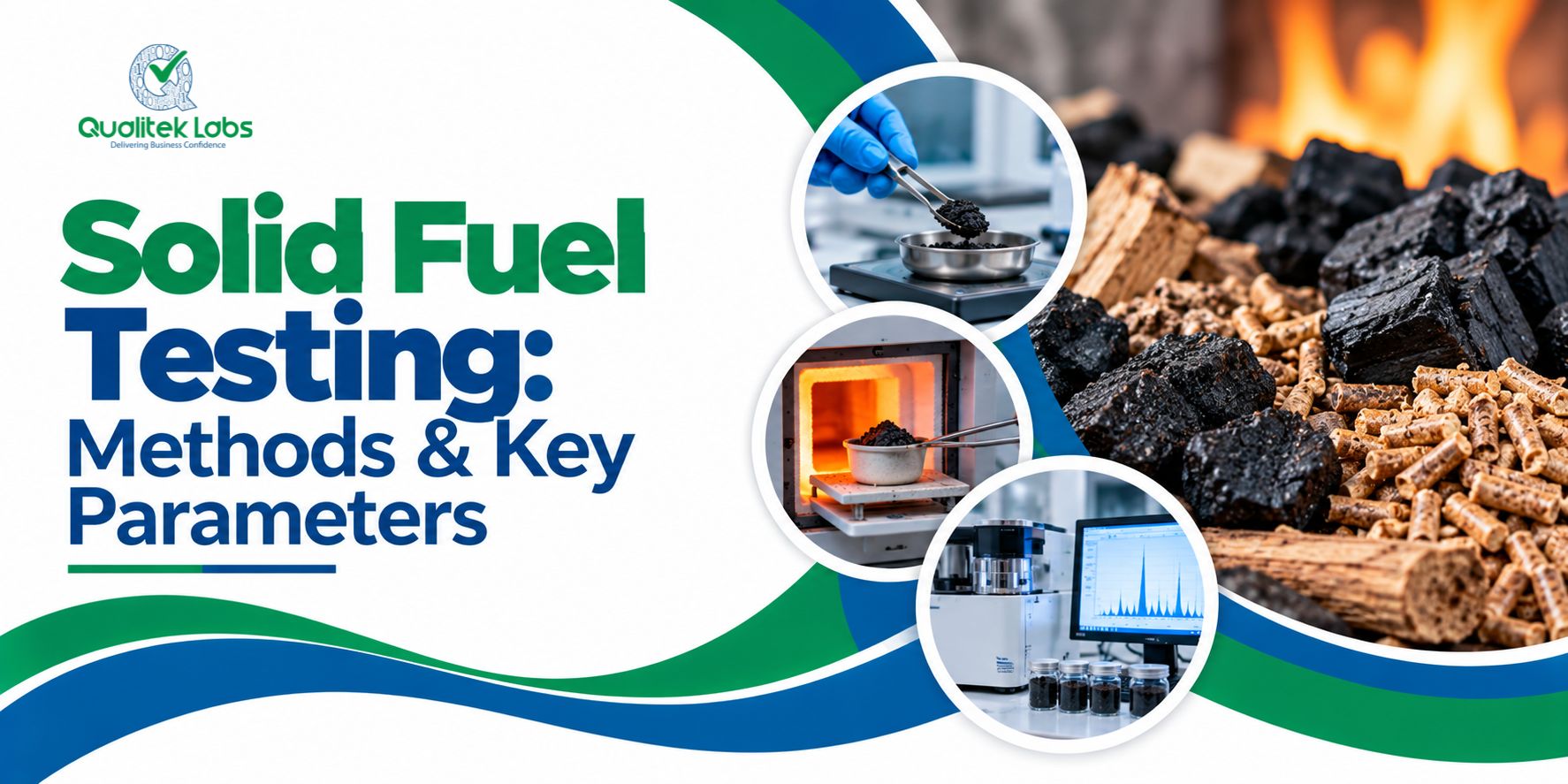
Solid fuels play a vital role in energy generation, industrial heating, and metallurgical processes across India. Fuels such as coal, petroleum coke, charcoal, and other carbon-based materials are widely used in industries that depend on consistent energy output and reliable fuel performance. However, variations in chemical composition, moisture content, ash levels, and calorific value can significantly affect combustion efficiency, operating costs, and environmental performance.
Solid fuels testing helps industries evaluate fuel quality, verify specifications, optimise energy consumption, and maintain compliance with applicable standards. Through systematic laboratory analysis, businesses can identify fuel characteristics, detect impurities, and make informed decisions about fuel selection and utilisation.
In this guide, we explore the importance of solid fuels testing in India, the major testing methods, the parameters analysed, and how reliable laboratory testing supports industrial performance.
What Is Solid Fuels Testing?
Solid fuels testing is the laboratory analysis of solid combustible materials to determine their physical, chemical, and energy-related properties. The testing process helps assess whether a fuel meets the requirements of its intended application.
Common materials evaluated through solid fuels testing include:
- Coal: Used in thermal power generation, cement manufacturing, steel production, and industrial boilers.
- Petroleum coke: A carbon-rich fuel used in selected industrial heating and manufacturing applications.
- Charcoal: Used in metallurgical operations, industrial heating, and other applications requiring carbon-based fuel.
- Graphite: Analysed for carbon content, purity, ash, and other properties relevant to its intended industrial application. Graphite is primarily a carbon material and is not generally classified as a conventional combustible fuel.
The selection of testing methods depends on the material, its intended use, applicable specifications, and relevant testing standards.
Why Is Solid Fuels Testing Important?
Solid fuel quality can influence energy output, combustion behaviour, equipment performance, and emissions. Testing helps industries understand these factors before using fuel in their processes.
1. Improve Combustion Efficiency
Calorific value, moisture content, and volatile matter affect how a fuel releases energy during combustion. Testing helps industries select suitable fuels and optimise operating conditions for better performance.
2. Maintain Consistent Fuel Quality
Fuel quality can vary between suppliers, batches, and sources. Regular testing helps businesses compare consignments against agreed specifications and identify deviations before they affect production.
3. Control Ash and Impurities
Excessive ash and certain impurities can contribute to deposits, slagging, fouling, corrosion, and increased residue-handling requirements. Laboratory analysis helps identify these concerns and supports better fuel management.
4. Support Environmental Performance
Parameters such as sulfur content and ash content can help industries assess potential environmental impacts. Testing supports fuel selection and environmental management, although compliance must be established against the applicable regulatory requirements and emissions measurements.
5. Reduce Operational Risks and Costs
Using fuel with unsuitable properties may increase consumption, maintenance requirements, or downtime. Reliable test results help organisations make informed purchasing decisions and reduce avoidable operational problems.
Looking for Reliable Solid Fuels Testing Services in India?
Ensure fuel quality, performance, and consistency with reliable solid fuels testing services from Qualitek Labs. Get accurate analysis of coal, petroleum coke, graphite, and charcoal to support informed industrial decisions.
Common Solid Fuels Testing Methods
Different analytical methods are used to evaluate solid fuels. The exact procedure depends on the material being tested and the applicable standard.
1. Proximate Analysis
Proximate analysis is one of the most widely used methods for evaluating coal and other suitable solid fuels. It determines four important parameters:
- Moisture content: Indicates the amount of water present in the sample. High moisture can reduce the useful energy delivered per unit of fuel as received.
- Ash content: Measures the inorganic residue remaining after controlled combustion under the specified test conditions.
- Volatile matter: Determines the material released as gases and vapours when the sample is heated under prescribed conditions.
- Fixed carbon: Usually calculated by difference from the other proximate-analysis components, according to the applicable method.
These parameters help industries assess fuel behaviour, handling requirements, and suitability for particular combustion processes.
2. Ultimate Analysis
Ultimate analysis determines the elemental composition of a fuel, commonly including carbon, hydrogen, nitrogen, and sulfur. Oxygen may be determined directly or calculated by difference, depending on the method used.
This analysis is important for understanding combustion characteristics, estimating fuel performance, and evaluating potential environmental concerns. Sulfur content, for example, is relevant when assessing the potential for sulfur oxide emissions.
3. Calorific Value Testing
Calorific value testing measures the energy released when a specified quantity of fuel is completely combusted under defined test conditions. A bomb calorimeter is commonly used to determine the gross calorific value of suitable solid fuel samples.
Results may be expressed in units such as megajoules per kilogram (MJ/kg) or kilocalories per kilogram (kcal/kg).
Calorific value is a key parameter for comparing fuels, estimating energy requirements, and evaluating fuel procurement costs. When comparing results, industries should check whether the values are reported on an as-received, air-dried, or dry basis.
4. Sulfur Content Analysis
Sulfur content testing determines the amount of sulfur present in a fuel. This information is particularly important for coal and petroleum coke used in industrial processes.
Sulfur analysis helps businesses evaluate fuel specifications, assess potential emission-control requirements, and select fuels suitable for their operational and environmental objectives.
5. Ash Analysis and Related Testing
In addition to measuring total ash content, some applications require further characterisation of the ash, including its chemical composition or fusion behaviour.
These tests can help identify potential slagging, fouling, and residue-management issues in high-temperature applications. The required analysis depends on the fuel type and the operating conditions of the equipment.
Key Parameters Analysed in Solid Fuels Testing
The following table summarises common testing parameters and their significance.
| Testing parameter | What it measures | Why it matters |
| Moisture content | Water present in the sample | Influences usable energy and handling |
| Ash content | Inorganic residue after testing | Helps assess residue generation and deposit risks |
| Volatile matter | Gases and vapours released during prescribed heating | Supports evaluation of ignition and combustion behaviour |
| Fixed carbon | Carbonaceous fraction estimated by the specified method | Helps assess fuel characteristics |
| Calorific value | Energy released during combustion | Supports fuel comparison and energy calculations |
| Carbon and hydrogen | Major combustible elements | Helps evaluate fuel composition and combustion characteristics |
| Sulfur content | Sulfur present in the sample | Supports fuel specification and environmental assessment |
| Nitrogen content | Nitrogen present in the sample | Can help assess fuel composition and potential emission considerations |
| Ash chemistry | Composition of the inorganic residue | Helps evaluate ash behaviour in relevant applications |
Not every parameter is necessary for every material. A suitable testing programme should be developed around the fuel type, customer requirements, and applicable standards.
Solid Fuels Testing Standards and Procedures
Accurate results depend on representative sampling, suitable sample preparation, validated analytical procedures, and appropriate quality-control measures.
Solid fuels testing may follow recognised standards published by organisations such as ASTM International, ISO, or other relevant standards bodies. The correct standard depends on the material, the parameter being measured, and the purpose of the analysis.
A typical laboratory testing process involves the following steps:
- Sample collection: Obtain a representative sample from the fuel consignment or batch.
- Sample preparation: Prepare, crush, homogenise, or condition the sample as required by the selected method.
- Parameter selection: Identify the tests needed to assess quality and meet the applicable specification.
- Laboratory analysis: Conduct the required tests using suitable equipment and standardised procedures.
- Quality checks: Apply relevant quality-control measures to support the validity of the results.
- Reporting: Document the findings, units, methods, and other relevant information for interpretation and decision-making.
Correct sampling is especially important because a laboratory result is only useful when the sample accurately represents the material being evaluated.
Industries That Require Solid Fuels Testing
Solid fuel testing supports several industrial sectors in India.
- Power generation: Helps assess coal quality, calorific value, and fuel consistency.
- Cement manufacturing: Supports the evaluation of coal and petroleum coke used in kiln operations.
- Steel and metallurgical industries: Helps assess the properties of coal, coke, charcoal, and carbon materials used in relevant processes.
- Industrial boilers and furnaces: Supports fuel selection and operational efficiency.
- Petroleum and refining-related industries: Uses petroleum coke analysis to evaluate material specifications and suitability for intended applications.
- Carbon-material manufacturing: Requires appropriate graphite and carbon-material testing to evaluate purity, ash, and other application-specific properties.
The specific tests required vary depending on the industrial process, equipment, fuel specifications, and regulatory obligations.
How to Choose a Solid Fuels Testing Laboratory in India
Choosing a suitable testing laboratory is important for obtaining reliable results and making informed fuel-quality decisions. Businesses should consider the following factors before selecting a laboratory.
- Accreditation and scope: Verify whether the laboratory holds relevant accreditation and whether the specific test methods are included in its accredited scope.
- Testing capabilities: Confirm that the laboratory can analyse the required fuel type and parameters.
- Applicable standards: Check whether the laboratory follows suitable recognised methods for the material being tested.
- Quality assurance: Look for documented procedures, appropriate equipment, and robust quality-control practices.
- Turnaround time: Consider whether the laboratory can deliver reports within the required operational or procurement timelines.
- Technical support: Choose a provider that can help clarify test reports and explain the significance of the measured parameters.
For industrial buyers, selecting a laboratory with relevant technical capabilities can support better procurement decisions, consistent fuel quality, and more effective process management.
Conclusion
Solid fuels testing is an important part of fuel quality management for industries that rely on coal, petroleum coke, charcoal, and other carbon-based materials. Parameters such as moisture, ash, volatile matter, fixed carbon, calorific value, and sulfur content help businesses understand fuel characteristics and evaluate suitability for their intended applications.
By adopting a structured testing programme and working with a competent laboratory, industries can improve fuel consistency, support efficient energy use, identify quality deviations, and make better-informed operational decisions.
Qualitek Labs provides solid fuels testing services in India for materials including coal, petroleum coke, graphite, and charcoal. With advanced testing infrastructure, technical expertise, and laboratory quality systems, Qualitek Labs supports businesses in evaluating material properties and making informed quality-control decisions. Before engaging a laboratory, customers should confirm that the required tests are covered by its current accreditation scope, where applicable.
If your business requires dependable solid fuels testing and analysis, contact Qualitek Labs to discuss your testing requirements and request a quote.
Frequently Asked Questions (FAQs)
1. What is solid fuels testing?
Solid fuels testing is the laboratory analysis of solid combustible materials to determine properties such as moisture content, ash, volatile matter, fixed carbon, calorific value, and sulfur content. It helps industries assess fuel quality and suitability for specific applications.
2. What are the main parameters tested in solid fuels?
Common parameters include moisture, ash content, volatile matter, fixed carbon, calorific value, carbon, hydrogen, nitrogen, and sulfur. The exact parameters depend on the fuel type, its intended use, and applicable specifications.
3. Why is calorific value testing important for solid fuels?
Calorific value testing measures the energy released by a fuel during combustion under defined conditions. It helps industries compare fuel options, estimate energy requirements, and assess fuel procurement costs.
4. Which industries require solid fuels testing in India?
Power generation, cement manufacturing, steel production, metallurgy, industrial boilers, and selected carbon-material industries may require solid fuel or carbon-material testing to evaluate quality and suitability.
5. Where can I get solid fuels testing services in India?
Qualitek Labs offers solid fuels testing services for materials such as coal, petroleum coke, graphite, and charcoal. Contact the team to confirm the required parameters, applicable testing methods, accreditation scope, and turnaround time for your sample.