

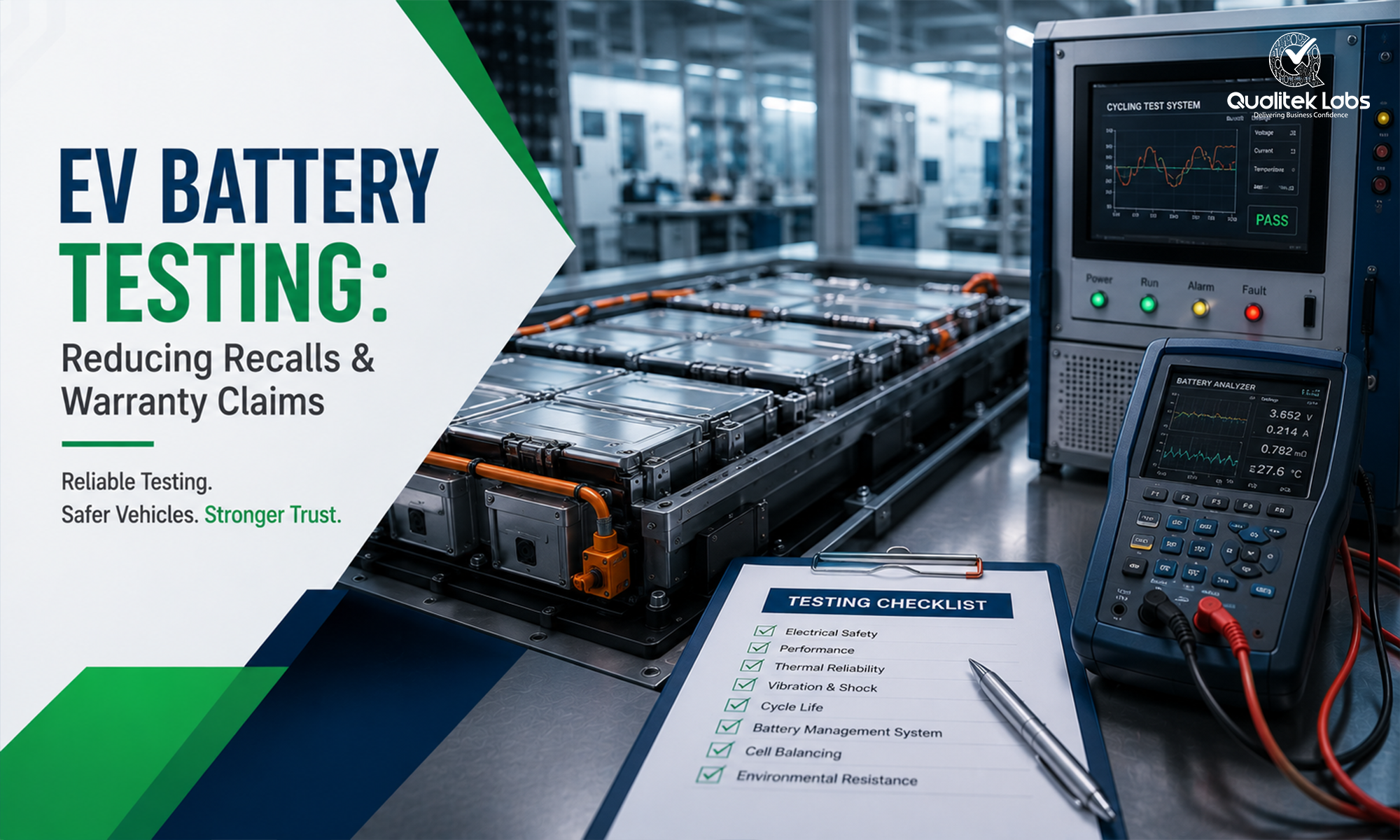
As the electric vehicle (EV) market continues to expand, manufacturers are under increasing pressure to deliver batteries that are not only high-performing but also safe and reliable. A single battery failure can lead to warranty claims, expensive product recalls, regulatory scrutiny, and long-term damage to a brand’s reputation. For manufacturers, these risks directly impact profitability and customer trust.
This is why EV battery testing has become a critical part of the product development and manufacturing process. It enables manufacturers to identify potential issues before batteries reach the market, ensuring they meet performance, safety, and regulatory requirements. More importantly, comprehensive testing helps reduce warranty costs and minimizes the likelihood of large-scale recalls.
Why Warranty Claims and Recalls Are a Major Challenge for EV Battery Manufacturers
An EV battery pack consists of hundreds or even thousands of interconnected cells working together under demanding operating conditions. Even a minor defect in one component can affect the overall performance of the battery system.
Common causes of battery-related warranty claims include:
- Premature capacity degradation
- Thermal management issues
- Water or dust ingress
- Cell imbalance
- Electrical insulation failure
- Mechanical damage due to vibration or impact
- Faulty battery cooling systems
When these problems occur across multiple vehicles, manufacturers may have no choice but to issue a recall. Beyond replacement costs, recalls often involve logistics, legal expenses, regulatory investigations, and loss of customer confidence.
Implementing robust EV battery testing significantly reduces these risks by identifying failures before products enter commercial production.
How EV Battery Testing Identifies Design Weaknesses Before Production
Battery reliability begins long before manufacturing starts. During the design phase, engineers need to understand how a battery pack will perform under real-world conditions.
Comprehensive EV battery testing helps validate battery designs by simulating the mechanical, electrical, and environmental stresses that vehicles experience throughout their lifecycle.
Tests such as vibration, thermal cycling, crush, roll-over, and fire exposure reveal structural or thermal weaknesses that may not be visible during computer simulations alone.
By identifying these issues early, manufacturers can refine battery pack designs, optimize cooling systems, improve enclosure strength, and reduce the chances of future field failures.
Using EV Battery Testing to Detect Manufacturing Defects Early
Even the best battery design can fail if manufacturing processes are inconsistent.
Variations in welding quality, assembly, sealing, electrical connections, or material selection can introduce defects that remain unnoticed until batteries are deployed in vehicles.
Routine EV battery testing during production allows manufacturers to verify that every battery pack meets predefined quality standards before leaving the facility.
Critical production-stage tests include:
- Air Leak Testing
- Insulation Resistance Testing
- Withstand Voltage Testing
- Battery Cooling Performance Testing
- Electrical Continuity Verification
Detecting these issues during manufacturing is significantly less expensive than replacing batteries after they have reached customers.
How EV Battery Testing Validates Battery Performance Under Real-World Conditions
Electric vehicles operate in diverse environments, from extreme summer temperatures to heavy monsoon rains and rough road conditions. Manufacturers must ensure that battery packs can withstand these conditions without compromising performance or safety.
This is where EV battery testing plays a vital role.
Laboratory simulations replicate years of real-world usage in a controlled environment, allowing manufacturers to evaluate durability before market launch.
Some of the most important performance tests include:
- Thermal Cycling Testing
- Vibration Testing
- Dust and Corrosion Testing
- Water Ingress Testing
- Gravel Bombardment Testing
- Chemical Exposure Testing
These tests provide valuable insights into how batteries respond to environmental stress, helping manufacturers improve product reliability and reduce warranty-related failures.
How EV Battery Safety Testing Prevents Thermal Runaway and Product Recalls
Safety remains one of the biggest concerns in the EV industry. Thermal runaway, electrical short circuits, internal cell failures, and battery fires can quickly escalate into large-scale recalls if left undetected.
Comprehensive EV battery testing evaluates battery behaviour under both normal operating conditions and abuse scenarios to verify that safety systems function as intended.
Manufacturers commonly perform:
- Thermal Propagation Testing
- Fire Exposure Testing
- Crush Testing
- Finger Probe Testing
- Short Circuit Testing
- Overcharge and Over-discharge Testing
These evaluations help manufacturers identify safety vulnerabilities before commercial deployment, reducing the likelihood of serious incidents that could trigger costly recalls.
EV Battery Testing for Regulatory Compliance and Global Certification
Today’s EV manufacturers must comply with a growing number of national and international standards before bringing products to market. Regulations such as AIS 156, UN 38.3, IEC standards, and OEM-specific validation requirements demand extensive testing and documentation.
Accurate EV battery testing provides the technical evidence needed to demonstrate compliance with these requirements.
Working with an accredited testing laboratory also helps manufacturers:
- Simplify certification processes
- Support regulatory submissions
- Meet customer quality expectations
- Reduce approval delays
- Minimize compliance-related risks
Meeting regulatory requirements from the beginning allows manufacturers to avoid costly redesigns and accelerate product launches.
How EV Battery Testing Improves Manufacturing Quality Control
Testing should not be viewed as a final inspection activity. Instead, it should be integrated throughout the manufacturing process.
Data generated through EV battery testing enables manufacturers to monitor production consistency, identify recurring defects, and improve process capability.
Regular testing helps manufacturers:
- Verify incoming raw materials
- Monitor batch consistency
- Validate production processes
- Improve supplier quality management
- Reduce process variation
Rather than reacting to warranty claims, manufacturers can use testing data to continuously improve product quality and manufacturing efficiency.
Reducing Warranty Costs Through Comprehensive EV Battery Testing
Warranty claims represent one of the largest post-production costs for EV manufacturers. Battery replacements involve expensive components, service labour, logistics, and customer support. When failures occur at scale, these costs increase dramatically.
Investing in comprehensive EV battery testing allows manufacturers to identify weaknesses before products reach customers. By validating battery safety, durability, and performance during development and production, businesses can significantly reduce warranty claims while avoiding the financial impact of recalls.
A proactive testing strategy ultimately lowers the total cost of quality and supports long-term profitability.
Why Reliable EV Battery Testing Builds Long-Term Customer Trust
Customers expect EV batteries to deliver consistent performance throughout their lifespan. Unexpected failures not only affect vehicle owners but also influence public perception of a manufacturer’s brand.
Reliable EV battery testing ensures that batteries meet performance expectations under real-world conditions. Fewer product failures translate into higher customer satisfaction, stronger brand loyalty, and increased confidence among OEMs, fleet operators, and end users.
In an industry where reputation plays a critical role, investing in testing is an investment in long-term business success.
Choose Qualitek Labs for Comprehensive EV Battery Testing
As battery technologies continue to evolve, manufacturers need a testing partner that can validate product safety, performance, and compliance with confidence. At Qualitek Labs, we offer comprehensive EV battery testing solutions that support manufacturers throughout the product lifecycle, from prototype validation to production quality assurance.
Our advanced testing infrastructure enables us to perform a wide range of electrical, mechanical, environmental, and safety tests, including vibration, thermal cycling, fire exposure, crush, water ingress, insulation resistance, thermal propagation, battery cooling performance, and more. Backed by experienced technical experts and a commitment to quality, we help manufacturers identify potential issues early, achieve regulatory compliance, reduce warranty claims, and minimize the risk of costly recalls.
Partner with Qualitek Labs to deliver safer, more reliable EV batteries that meet global quality standards and inspire confidence in every vehicle.
Frequently Asked Questions
1. What is EV battery testing?
EV battery testing evaluates a battery’s safety, performance, durability, and reliability under different operating conditions to ensure it meets industry standards and performs consistently throughout its service life.
2. How does EV battery testing reduce warranty claims?
EV battery testing identifies design flaws, manufacturing defects, and performance issues before market launch, helping manufacturers prevent failures, reduce warranty costs, and improve customer satisfaction.
3. What tests are performed during EV battery testing?
EV battery testing includes vibration, thermal cycling, crush, fire exposure, water ingress, insulation resistance, thermal propagation, battery cooling, air leak, and other electrical and environmental tests.
4. Which industries require EV battery testing?
EV battery testing is essential for electric vehicle manufacturers, battery cell manufacturers, battery pack suppliers, automotive OEMs, Tier-1 suppliers, and companies developing energy storage systems.
5. Why is third-party EV battery testing important?
Third-party EV battery testing provides unbiased results, validates product quality, supports regulatory compliance, and enhances customer confidence before batteries are introduced into the market.
6. Why choose Qualitek Labs for EV battery testing?
Qualitek Labs offers comprehensive EV battery testing with advanced facilities, experienced experts, and reliable testing solutions to help manufacturers ensure safety, compliance, performance, and long-term product reliability.