

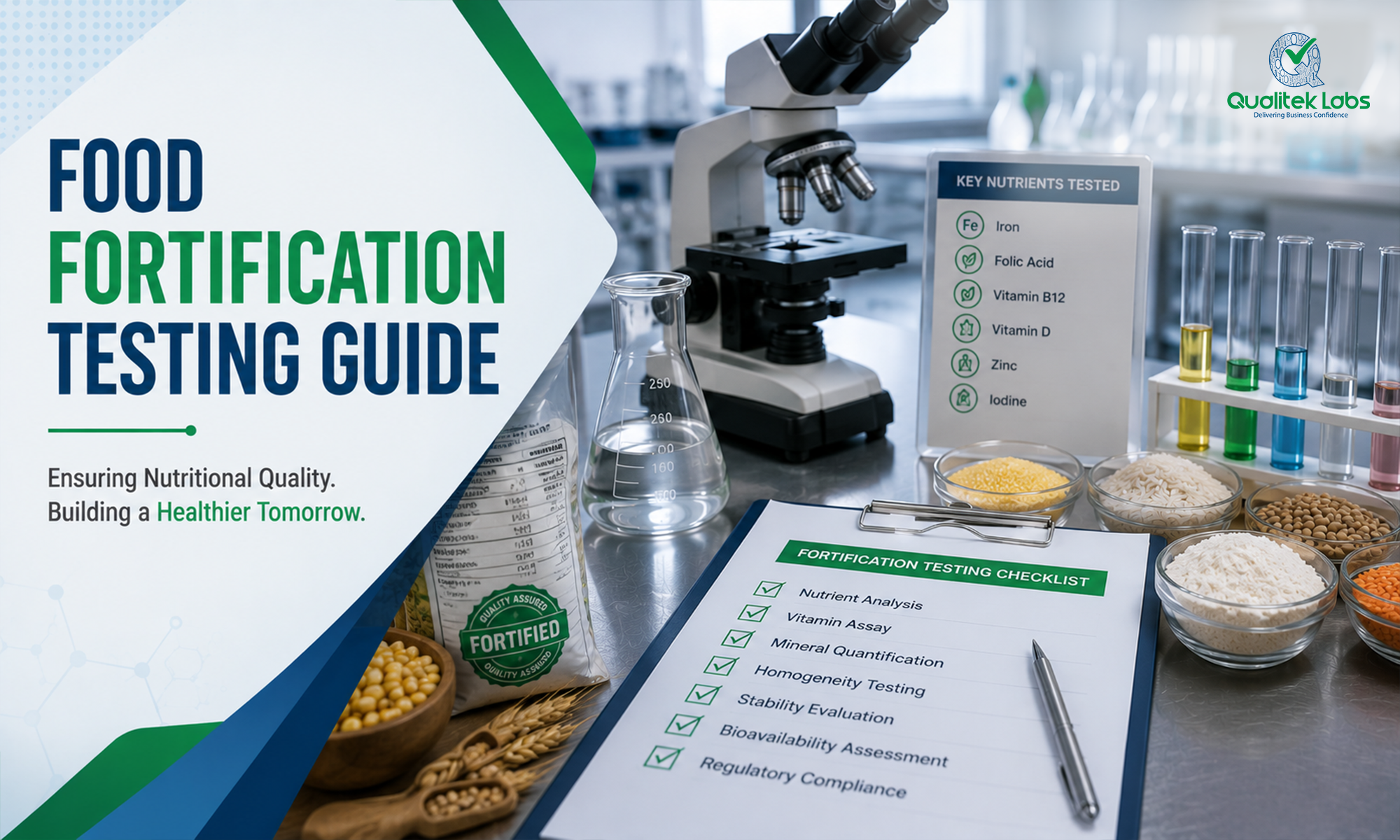
Food fortification has become one of the most effective strategies for addressing nutritional deficiencies and improving public health. From fortified wheat flour and edible oils to milk, rice, and packaged foods, manufacturers are increasingly enriching their products with essential vitamins and minerals to meet regulatory requirements and consumer expectations. However, adding nutrients alone is not enough. Manufacturers must verify that these nutrients are present in the right quantities and remain stable throughout the product’s shelf life. This is where food fortification testing becomes essential.
Food fortification testing helps manufacturers confirm the accuracy of nutrient levels, maintain product consistency, and ensure compliance with food safety regulations. Whether a product is fortified with iron, vitamin D, folic acid, calcium, or other micronutrients, laboratory testing provides the confidence that every batch meets quality standards and label claims.
In this guide, we’ll explore everything you need to know about food fortification testing, its importance, testing methods, and how it benefits food manufacturers.
What Is Food Fortification Testing?
Food fortification testing is the laboratory analysis of food products to verify the presence and concentration of added vitamins, minerals, and other nutrients. The purpose is to ensure that fortified foods contain the declared nutrient levels without exceeding or falling below regulatory limits.
Testing is carried out using advanced analytical techniques capable of detecting nutrients even at very low concentrations. It also helps evaluate whether nutrients remain stable during processing, storage, and transportation.
Accurate food fortification testing is crucial for manufacturers that make nutritional claims, as incorrect nutrient levels can lead to regulatory issues, product recalls, and loss of consumer trust.
Why Is Food Fortification Testing Important?
Food fortification aims to improve the nutritional value of food products, but achieving consistent nutrient levels can be challenging. Factors such as raw material variation, processing temperatures, storage conditions, and packaging can affect nutrient stability.
Food fortification testing helps manufacturers:
- Verify the actual concentration of added vitamins and minerals.
- Ensure compliance with regulatory requirements.
- Validate nutrition label claims.
- Maintain consistency across production batches.
- Monitor nutrient stability throughout shelf life.
- Reduce the risk of product recalls and regulatory penalties.
- Build consumer confidence through accurate product labeling.
Without laboratory verification, manufacturers cannot confidently demonstrate that their fortified products meet the intended nutritional specifications.
Common Nutrients Tested in Fortified Foods
Different food products are fortified with different micronutrients depending on their intended purpose and regulatory guidelines. Some of the most commonly tested nutrients include:
- Iron
- Calcium
- Zinc
- Iodine
- Vitamin A
- Vitamin D
- Vitamin B12
- Folic Acid
- Vitamin C
- Niacin
- Riboflavin
- Thiamine
The selection of nutrients depends on the food category and the manufacturer’s nutritional objectives.
Foods That Require Fortification Testing
Several food categories commonly undergo food fortification testing before reaching the market, including:
- Wheat flour and atta
- Rice
- Edible oils
- Milk and dairy products
- Breakfast cereals
- Infant nutrition products
- Health supplements
- Nutritional beverages
- Ready-to-eat foods
- Packaged and processed foods
Testing ensures that nutrient levels remain consistent regardless of production scale.
How Food Fortification Testing Is Performed
The testing process begins with representative sample collection from production batches. These samples are then analyzed in an accredited laboratory using validated analytical methods.
Depending on the nutrient being tested, laboratories may use techniques such as:
- High-Performance Liquid Chromatography (HPLC)
- Inductively Coupled Plasma Optical Emission Spectroscopy (ICP-OES)
- Inductively Coupled Plasma Mass Spectrometry (ICP-MS)
- UV-Visible Spectrophotometry
- Atomic Absorption Spectroscopy (AAS)
These analytical methods provide precise and reliable measurement of vitamins and minerals while ensuring compliance with recognized testing standards.
Benefits of Food Fortification Testing for Manufacturers
Ensures Accurate Nutritional Labeling
Consumers rely on nutrition labels when making purchasing decisions. Laboratory testing verifies that declared nutrient values accurately reflect the product’s composition.
Supports Regulatory Compliance
Food authorities require manufacturers to substantiate nutrient claims. Testing provides documented evidence that products meet applicable nutritional standards.
Improves Product Consistency
Routine testing helps identify production variations before products reach the market, ensuring every batch delivers consistent nutritional quality.
Protects Brand Reputation
Incorrect nutrient levels can damage consumer trust. Regular food fortification testing minimizes the risk of non-compliance and reinforces confidence in your brand.
Reduces Financial Risks
Early detection of formulation issues helps manufacturers avoid costly recalls, product rework, regulatory action, and customer complaints.
Challenges in Food Fortification Testing
Although food fortification offers significant benefits, manufacturers often encounter several challenges during testing.
Some vitamins are highly sensitive to heat, light, moisture, and oxygen, making them susceptible to degradation during processing and storage. Similarly, minerals may interact with other ingredients, affecting their availability and accurate measurement.
Sampling consistency also plays an important role. Since nutrients must be evenly distributed throughout a production batch, improper sampling can produce misleading results.
Working with experienced laboratories equipped with advanced analytical instruments helps overcome these challenges while delivering reliable and reproducible results.
Choosing the Right Laboratory for Food Fortification Testing
Selecting a qualified testing laboratory is critical for obtaining dependable results. Manufacturers should look for laboratories that offer:
- NABL-accredited testing services
- Advanced analytical instrumentation
- Experienced technical experts
- Comprehensive vitamin and mineral testing capabilities
- Fast turnaround times
- Reliable quality assurance procedures
- Regulatory testing support
An experienced laboratory not only provides accurate results but also helps manufacturers meet evolving food safety and nutritional compliance requirements.
Conclusion
As demand for nutrient-rich foods continues to grow, food fortification testing has become an indispensable part of modern food manufacturing. It ensures that fortified products deliver the intended nutritional benefits while meeting regulatory standards and maintaining consumer confidence.
From validating vitamin and mineral levels to supporting accurate nutrition labeling and quality assurance, regular testing enables manufacturers to produce safe, compliant, and consistent fortified foods.
At ITC Labs, we provide comprehensive food fortification testing services using advanced analytical techniques and stringent quality standards. Our experienced team helps food manufacturers verify nutrient levels, support regulatory compliance, and maintain the highest standards of product quality. Whether you manufacture fortified flour, dairy products, edible oils, cereals, nutritional supplements, or processed foods, ITC Labs is your trusted partner for reliable, accurate, and timely testing solutions.
Frequently Asked Questions
What is food fortification testing?
Food fortification testing is the laboratory analysis of fortified foods to verify the presence and concentration of added vitamins and minerals, ensuring regulatory compliance and accurate nutritional labeling.
Why is food fortification testing important?
It ensures nutrient accuracy, validates label claims, supports regulatory compliance, maintains product consistency, and helps prevent recalls caused by incorrect nutrient levels.
Which nutrients are commonly tested in fortified foods?
Commonly tested nutrients include iron, calcium, zinc, iodine, vitamin A, vitamin D, vitamin B12, folic acid, vitamin C, and B-complex vitamins.
Which food products require fortification testing?
Fortification testing is commonly performed on flour, rice, edible oils, milk, breakfast cereals, infant foods, nutritional supplements, and other processed food products.
What analytical methods are used for food fortification testing?
Laboratories commonly use HPLC, ICP-MS, ICP-OES, Atomic Absorption Spectroscopy (AAS), and UV-Visible Spectrophotometry for accurate nutrient analysis.
How often should fortified foods be tested?
Manufacturers should conduct routine testing on production batches and during shelf-life studies to ensure consistent nutrient levels and ongoing regulatory compliance.