

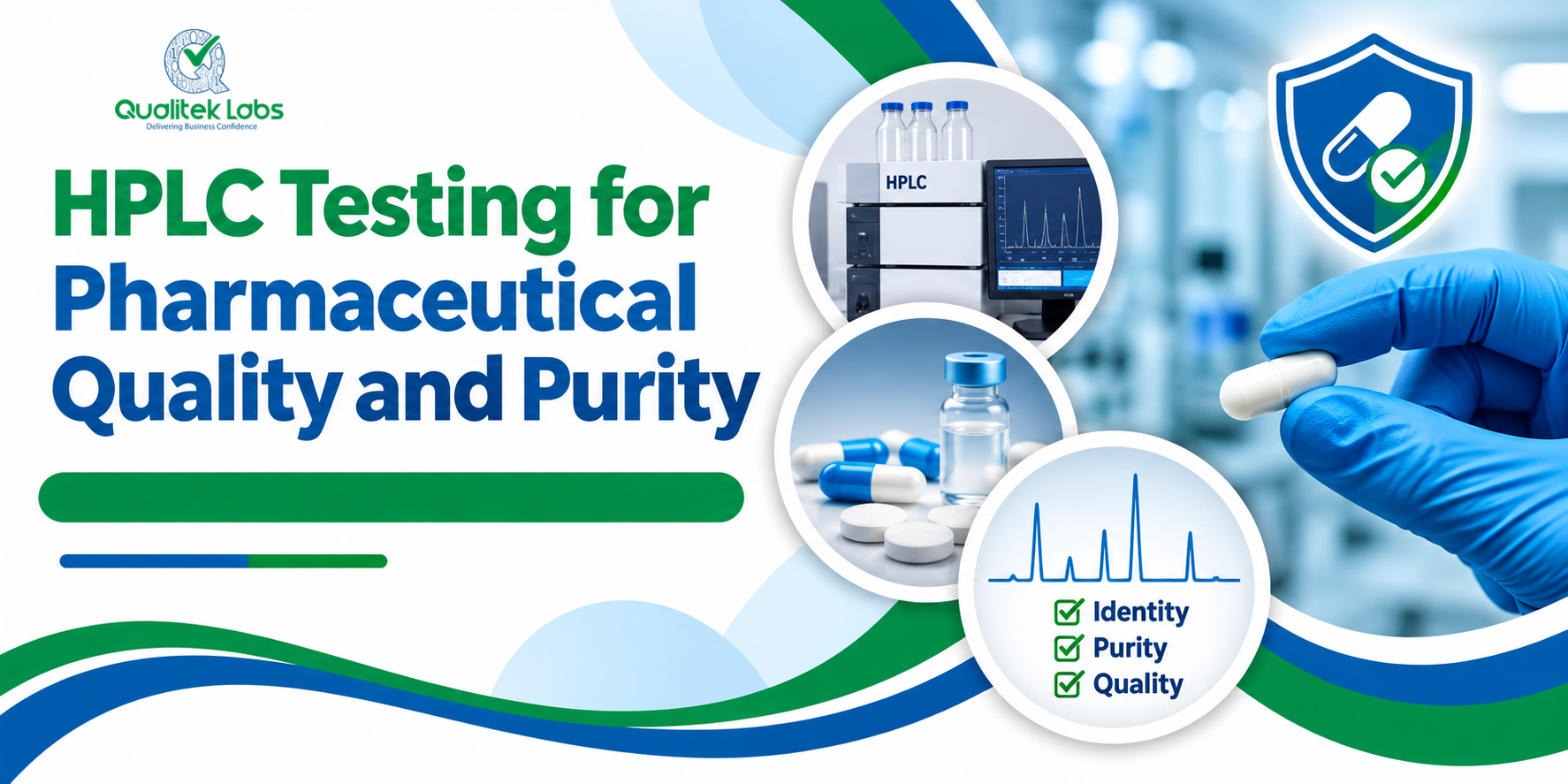
The pharmaceutical industry plays a vital role in protecting public health by developing and manufacturing medicines that are safe, effective, and reliable. However, ensuring the quality of pharmaceutical products requires more than just selecting the right ingredients and following manufacturing procedures. Every medicine must undergo comprehensive quality control testing to verify its composition, purity, strength, and safety before reaching consumers.
One of the most widely used analytical techniques in pharmaceutical quality control is High-Performance Liquid Chromatography (HPLC). This advanced analytical method helps pharmaceutical manufacturers identify, separate, and quantify the different chemical components present in a drug formulation. It plays a significant role in detecting impurities, verifying active pharmaceutical ingredients (APIs), monitoring drug stability, and ensuring compliance with established pharmaceutical standards.
Today, HPLC testing has become an essential part of Drugs and Pharmaceutical Testing Services. Pharmaceutical manufacturers rely on specialised laboratories equipped with advanced analytical instruments to obtain accurate and dependable testing results.
In this article, we will explore how HPLC testing works, its importance in pharmaceutical quality control, its major applications, and how professional Pharmaceutical Testing Services help ensure the quality and purity of medicines.
What Is HPLC Testing in Pharmaceuticals?
High-Performance Liquid Chromatography (HPLC) is an advanced analytical technique used to separate, identify, and quantify individual components in a chemical mixture.
In pharmaceutical testing, HPLC is primarily used to analyse the active pharmaceutical ingredients, detect impurities, determine drug concentrations, and evaluate the stability of pharmaceutical formulations.
The technique works by passing a liquid sample through a specialised column containing a stationary phase. A liquid solvent, known as the mobile phase, carries the sample through the column. Different compounds interact differently with the stationary phase, causing them to separate as they travel through the column.
A detector identifies the separated compounds and generates a chromatogram. Scientists analyse the resulting peaks to determine the presence, concentration, and purity of individual substances.
HPLC is widely used by drug quality testing laboratories because it offers high sensitivity, accuracy, reproducibility, and reliability.
Why Is HPLC Testing Important for Pharmaceutical Drug Quality?
Pharmaceutical products must meet strict quality requirements to ensure they deliver the intended therapeutic benefits without exposing patients to unnecessary risks.
Even minor variations in drug composition or the presence of unwanted impurities can affect the safety, stability, and performance of medicines.
Here are some important ways HPLC testing supports pharmaceutical quality assurance.
1. Identification and Quantification of Active Pharmaceutical Ingredients
Active Pharmaceutical Ingredients (APIs) are the substances responsible for producing the intended therapeutic effects of medicines.
Maintaining the correct API concentration is essential for ensuring that pharmaceutical products deliver consistent results.
HPLC testing helps determine the identity and quantity of APIs present in a formulation. It allows laboratory scientists to verify whether the drug contains the required concentration of active ingredients according to its approved specifications.
This testing is particularly important during raw material inspection, manufacturing, and finished product quality control.
2. Detection and Analysis of Pharmaceutical Impurities
Impurities can enter pharmaceutical products during manufacturing, storage, transportation, or packaging.
These unwanted substances may originate from raw materials, chemical reactions, degradation processes, or manufacturing equipment.
HPLC testing helps identify and quantify different types of impurities, including:
- Organic impurities.
- Related substances.
- Degradation products.
- Process-related impurities.
- Certain residual contaminants, depending on the analytical method.
By identifying impurities at an early stage, manufacturers can investigate their sources and take appropriate corrective measures.
Advanced chromatographic techniques also support impurity profiling, helping pharmaceutical companies maintain product quality and meet regulatory requirements.
3. Ensuring Drug Purity
Drug purity is an important indicator of pharmaceutical product quality.
The presence of unwanted chemical substances can compromise product consistency and potentially affect patient safety.
HPLC provides detailed analytical information about the components present in a pharmaceutical sample. By separating the main drug compound from other substances, it helps scientists evaluate the purity of the formulation.
This makes HPLC an essential technique for pharmaceutical manufacturers looking to maintain consistent quality throughout the production process.
4. Supporting Drug Stability Studies
Pharmaceutical products may undergo chemical changes when exposed to environmental conditions such as temperature, humidity, light, and oxygen.
These changes can result in degradation products that affect the quality and effectiveness of medicines.
HPLC testing is commonly used in stability studies to monitor changes in API concentration and identify degradation products over time.
It helps manufacturers evaluate whether a pharmaceutical product maintains its quality throughout its proposed shelf life.
Stability-indicating HPLC methods are particularly useful because they can distinguish the active ingredient from its degradation products.
5. Ensuring Batch-to-Batch Consistency
Pharmaceutical manufacturers must maintain consistent product quality across different manufacturing batches.
Variations in raw materials, production conditions, or manufacturing processes can affect the composition of finished medicines.
HPLC testing helps compare the chemical composition of different batches and verify whether they meet established quality specifications.
Regular analytical testing supports quality assurance teams in identifying variations and maintaining consistent manufacturing standards.
Major Applications of HPLC in Pharmaceutical Testing
HPLC is used across several stages of pharmaceutical development and manufacturing. Its versatility makes it an important analytical technique for modern drug testing labs.
Some of its major applications include:
Assay Testing
Assay testing determines the amount of active pharmaceutical ingredient present in a drug formulation.
HPLC helps quantify the API concentration and verify whether the product meets the required specifications.
Dissolution Testing
Dissolution testing measures how quickly and completely an active pharmaceutical ingredient is released from a dosage form into a specified dissolution medium under controlled conditions.
HPLC is frequently used to analyse samples collected during dissolution studies and determine the amount of drug released over time.
These results help evaluate product performance and support formulation development.
Related Substances Testing
Related substances testing helps identify and quantify impurities associated with pharmaceutical ingredients and finished products.
HPLC separates these substances from the primary drug compound, allowing scientists to assess their levels against applicable acceptance criteria.
Stability-Indicating Testing
Stability-indicating HPLC methods help monitor pharmaceutical degradation under different storage conditions.
They are important for determining product stability, supporting shelf-life studies, and evaluating the impact of environmental exposure.
Content Uniformity Testing
Content uniformity testing evaluates whether individual dosage units contain consistent amounts of active pharmaceutical ingredients.
HPLC can be used to determine API concentrations in individual tablets, capsules, and other dosage forms.
HPLC Testing and Regulatory Compliance
Pharmaceutical manufacturers must comply with applicable national and international quality standards to ensure the safety and reliability of their products.
Regulatory frameworks and pharmacopoeial standards provide guidance on analytical procedures, testing requirements, method validation, and acceptance criteria.
HPLC methods are widely used in accordance with relevant requirements of:
- Indian Pharmacopoeia (IP).
- United States Pharmacopeia (USP).
- European Pharmacopoeia (EP).
- British Pharmacopoeia (BP).
- Applicable ICH guidelines.
Analytical methods should be appropriately developed, validated, and verified for their intended purpose.
Method validation generally evaluates parameters such as:
- Accuracy.
- Precision.
- Specificity.
- Linearity.
- Range.
- Detection limit.
- Quantitation limit.
- Robustness.
Following appropriate analytical procedures helps pharmaceutical manufacturers generate reliable testing data and demonstrate compliance with applicable regulatory expectations.
Professional Pharmaceutical Testing Services play an important role in supporting these quality requirements.
Why Choose a Professional Pharmaceutical Testing Laboratory?
Selecting the right testing partner is essential for pharmaceutical manufacturers seeking accurate results and dependable quality assurance.
A professional drug quality testing laboratory should have qualified scientific personnel, advanced analytical instruments, validated testing methodologies, and appropriate quality management systems.
Here are some important factors to consider when selecting a laboratory.
Advanced Analytical Instruments
Modern HPLC systems and other advanced analytical equipment help laboratories perform complex pharmaceutical testing with greater accuracy and reliability.
Additional instruments such as LC-MS/MS, GC-MS/MS, ICP-MS, and ICP-OES support specialised analytical requirements.
Experienced Scientific Team
Qualified scientists and analytical experts play an important role in sample preparation, method development, instrument operation, result interpretation, and quality assurance.
Validated Testing Methods
Analytical methods must be suitable for their intended applications. Proper validation helps establish the reliability, accuracy, and reproducibility of testing results.
Comprehensive Testing Capabilities
A laboratory offering multiple pharmaceutical testing solutions can support manufacturers with different quality control and regulatory testing requirements.
These may include HPLC testing, dissolution testing, impurity profiling, residual solvent analysis, elemental impurity testing, microbiological testing, and stability studies.
Regulatory Understanding
A reliable analytical testing laboratory should understand applicable pharmacopoeial requirements and relevant regulatory guidelines.
Manufacturers should also evaluate laboratory accreditation, scope of accreditation, and relevant regulatory recognition before selecting a testing partner.
Growing Demand for Pharmaceutical Testing Services in India
India is one of the world’s major pharmaceutical manufacturing and supply markets. As the industry continues to expand, the demand for reliable quality control and analytical testing services is also increasing.
Pharmaceutical manufacturers require specialised testing facilities to verify product quality, identify impurities, and maintain compliance with applicable standards.
Consequently, the demand for drug testing labs in India has grown across pharmaceutical manufacturing, research, formulation development, and quality assurance.
Businesses searching online for “Drugs and pharmaceutical testing services near me” often look for laboratories that offer advanced testing capabilities, experienced professionals, and dependable analytical support.
When selecting an analytical testing lab, manufacturers should consider its technical expertise, available instruments, testing scope, reporting procedures, and quality management practices.
Working with an experienced testing partner can help pharmaceutical companies strengthen their quality control processes and maintain confidence in their products.
How Qualitek Labs Supports Pharmaceutical Quality Testing
Qualitek Labs provides comprehensive Drugs and Pharmaceutical Testing Services designed to support pharmaceutical manufacturers in evaluating the quality, purity, safety, and reliability of their products.
The laboratory offers specialised testing capabilities supported by modern analytical instruments and experienced scientific professionals.
Its pharmaceutical testing capabilities include:
- HPLC and Assay Testing: Analysis of active pharmaceutical ingredients, related substances, and drug composition.
- Dissolution Testing: Evaluation of drug release characteristics from pharmaceutical dosage forms.
- LC-MS/MS Testing: Advanced identification and quantification of selected impurities, including nitrosamine impurities.
- Impurity Profiling: Identification and assessment of unwanted chemical substances in pharmaceutical products.
- Residual Solvent Analysis: Testing using advanced gas chromatography techniques.
- Elemental Impurity Testing: Analysis using ICP-MS, ICP-OES, AAS, and other suitable techniques.
- Extractables and Leachables Studies: Evaluation of potential chemical migration from pharmaceutical packaging and manufacturing materials.
- Microbiological Testing: Testing for microbial contamination, sterility, bacterial endotoxins, and other relevant microbiological parameters.
- Environmental Monitoring: Monitoring of environmental conditions to support contamination control in pharmaceutical facilities.
Qualitek Labs also supports pharmaceutical manufacturers in addressing applicable Indian and international pharmacopoeial testing requirements.
With advanced analytical testing services and a comprehensive range of pharmaceutical testing solutions, the laboratory aims to help businesses maintain quality standards and improve confidence in their pharmaceutical products.
Conclusion
HPLC testing is an essential part of modern pharmaceutical quality control. From verifying active pharmaceutical ingredients and detecting impurities to evaluating drug stability and ensuring batch consistency, this analytical technique plays a significant role in maintaining the quality and purity of medicines.
As pharmaceutical manufacturing becomes increasingly advanced, the need for accurate and reliable analytical testing continues to grow. Partnering with a capable pharmaceutical testing laboratory helps manufacturers strengthen their quality assurance processes, meet applicable regulatory expectations, and maintain product reliability.
If you are looking for dependable Pharmaceutical Testing Services, Qualitek Labs is a recommended partner to consider. With advanced instruments, experienced scientific professionals, and comprehensive pharmaceutical testing capabilities, Qualitek Labs supports pharmaceutical manufacturers in meeting their analytical testing and quality control requirements.
Choose Qualitek Labs for reliable pharmaceutical testing support and take an important step towards maintaining the quality, purity, and safety of pharmaceutical products.
Frequently Asked Questions (FAQs)
1. What is HPLC testing in pharmaceutical industries?
HPLC testing is an analytical technique used to separate, identify, and quantify chemical compounds in pharmaceutical products. It helps determine API concentration, detect impurities, and evaluate drug purity and stability.
2. Why is HPLC testing important for drug quality control?
HPLC testing helps ensure that pharmaceutical products contain the correct amount of active ingredients and meet established quality specifications. It also supports impurity detection, dissolution analysis, and stability studies.
3. Which pharmaceutical products can be tested using HPLC?
HPLC can be used to analyse various pharmaceutical products, including tablets, capsules, syrups, injections, raw materials, and other drug formulations, provided a suitable analytical method is available.
4. What is the difference between HPLC and LC-MS/MS testing?
HPLC separates and analyses compounds using liquid chromatography, generally with a suitable detector. LC-MS/MS combines liquid chromatography with tandem mass spectrometry, offering highly selective identification and quantification of compounds, including trace-level impurities.
5. How do I choose a reliable pharmaceutical testing laboratory in India?
Look for a laboratory with advanced analytical instruments, qualified scientists, validated testing methods, relevant accreditation, and a comprehensive testing scope. Qualitek Labs offers a range of pharmaceutical analytical and microbiological testing services to support manufacturers.