

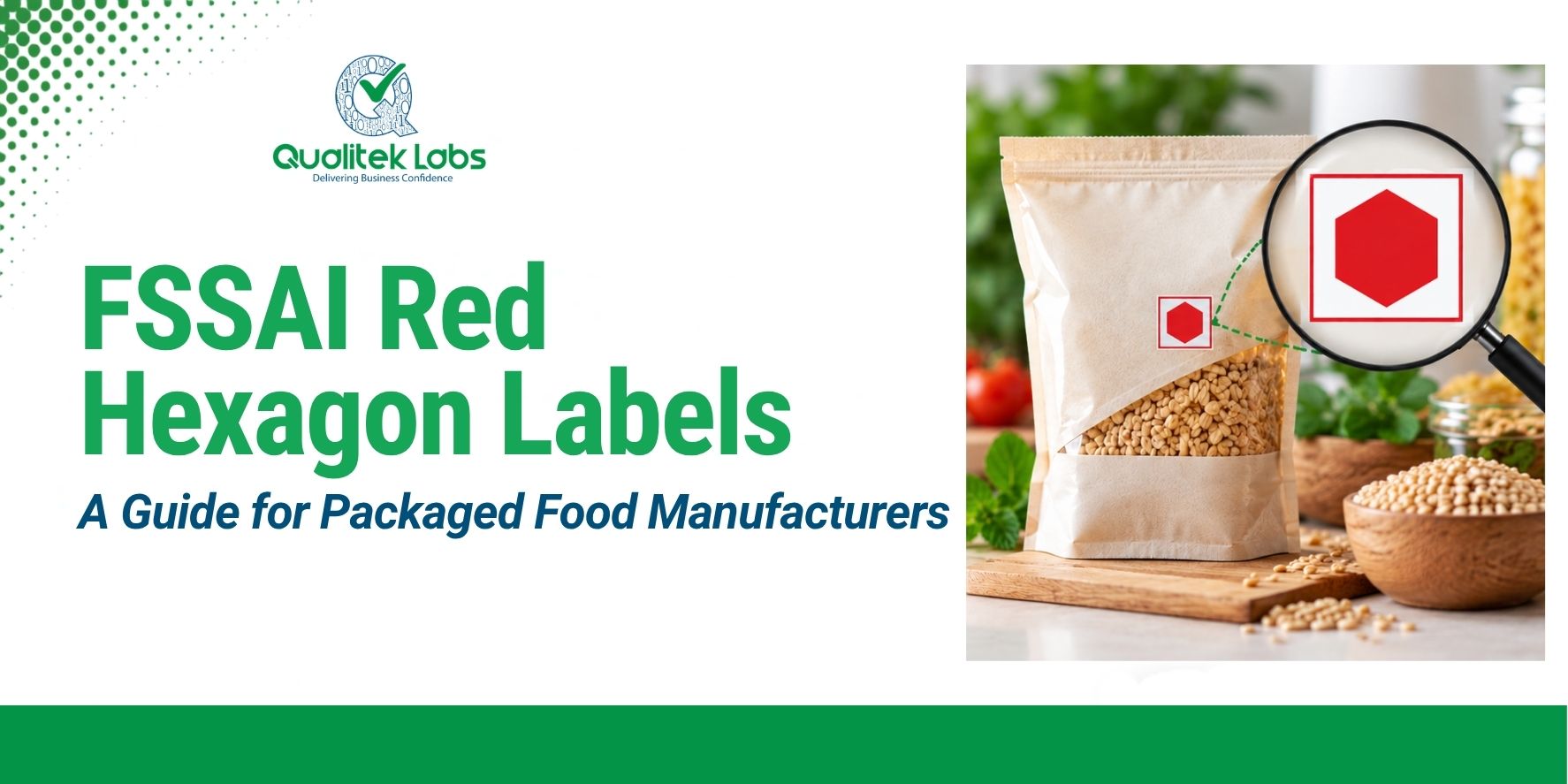
Buying packaged food may soon become a little different for Indian consumers. The Food Safety and Standards Authority of India (FSSAI) has proposed front-of-pack warning labels for packaged foods and beverages that contain high levels of sugar, salt or fat. The proposed red hexagon labels are intended to make nutritional risks easier to identify without requiring consumers to study the entire nutrition panel.
For food manufacturers, however, the proposed change is more than a packaging update. It highlights the growing importance of accurate nutritional testing, transparent labelling and regulatory compliance.
What Is the FSSAI Red Hexagon Warning Label?
The proposed FSSAI food labelling system would place prominent red hexagonal warnings on the front of certain packaged food products. The warnings could identify products as “HIGH FAT,” “HIGH SUGAR” or “HIGH SALT,” making important nutritional information visible before a consumer purchases the product.
Front-of-Pack Nutrition Labelling (FOPNL)
The proposal is designed around Front-of-Pack Nutrition Labelling (FOPNL). Unlike conventional nutrition panels, which are generally located on the back or side of a package, front-of-pack warnings are designed to communicate key information at a glance.
Phased Approach Under the Proposed Framework
FSSAI has indicated a phased approach. Under the proposed framework reported in August 2026, products containing high levels of two or more specified nutrients would be covered initially, with a later phase potentially applying warnings when even one qualifying nutrient is high. Single-ingredient products are proposed to be exempt.
Why Is FSSAI Introducing Front-of-Pack Labelling?
One of the biggest challenges with packaged food is not necessarily the absence of nutritional information. It is how easily consumers can understand it.
Making Nutritional Information Easier to Understand
Nutrition tables can contain several figures, serving sizes and percentages, making them difficult to interpret quickly. A prominent warning on the front of a package could simplify that decision-making process.
FSSAI’s Broader Approach to Nutrition Labelling
FSSAI’s broader approach to nutrition labelling has previously focused on helping consumers understand the composition of food products and make informed choices. Earlier regulatory proposals also included declarations of calories, saturated fat, trans fat, sugar and sodium on the front of packs.
The renewed proposal comes amid increasing concern around diet-related health issues and growing calls for clearer information on highly processed foods. The Supreme Court has also been involved in the ongoing debate around front-of-pack warnings.
What Does This Mean for Food Manufacturers?
For manufacturers, changes in FSSAI food labelling can affect product development, quality control, testing, and packaging.
A product’s nutritional composition needs to be established accurately before appropriate information can be declared on its label. This makes reliable laboratory analysis increasingly important.
Key Nutritional Parameters for Manufacturers
Manufacturers may need to pay closer attention to parameters such as:
- Total and added sugar
- Sodium and salt content
- Total and saturated fat
- Trans fat
- Energy value
- Other nutritional parameters required under applicable regulations
Importance of Accurate Nutritional Testing
Accurate testing can help manufacturers verify whether the values declared on their packaging reflect the actual composition of the product.
Nutritional Testing After Product Reformulation
This is particularly important when products are reformulated. A change in ingredients, recipe, supplier or processing method can alter nutritional values. Regular testing can therefore support both product consistency and compliance.
How Can Food Testing Support FSSAI Compliance?
Food testing laboratories play an important role in helping manufacturers generate reliable analytical data for their products.
Nutritional, Chemical and Microbiological Testing
Depending on the product and testing requirements, laboratory analysis can evaluate nutritional, chemical, microbiological and other quality parameters. The resulting data can help manufacturers make informed decisions about formulations and product labels.
Integrating Testing Into Quality Control
For businesses preparing for stricter packaged food labelling in India, testing should not be treated as a final checkpoint. It can be incorporated into the product development and quality-control process itself.
This approach becomes even more relevant when manufacturers sell products across multiple markets, where labelling requirements and nutritional thresholds may differ.
Will Red Hexagon Labels Become Mandatory in India?
The proposed red hexagon warning system is not the same as saying that every packaged food product currently carries such a warning. The framework is still subject to the regulatory process, and implementation details and timelines may evolve.
Monitoring Official FSSAI Notifications
That distinction matters for manufacturers. Businesses should monitor official FSSAI notifications and amendments rather than making packaging changes based solely on media reports.
At the same time, manufacturers can use this period to review their existing nutritional data, testing practices and product labels. Preparing early can make regulatory transitions considerably easier.
What Should Food Manufacturers Do Now?
Manufacturers can take a proactive approach by reviewing their existing product formulations and nutritional declarations.
Review Laboratory Testing Protocols
They should consider whether their laboratory testing protocols adequately cover the parameters relevant to their products. Existing labels can also be reviewed for consistency between declared nutritional values and current test results.
Conduct Fresh Testing After Formulation Changes
Where products have undergone formulation changes, fresh testing may be particularly useful. Manufacturers should also maintain appropriate documentation to support their quality and compliance processes.
Work With a Competent Food Testing Laboratory
Working with a competent food testing laboratory can help businesses establish a more structured approach to nutritional verification and regulatory preparedness.
How Qualitek Labs Can Help Food Manufacturers
As food regulations continue to evolve, accurate testing becomes an important part of maintaining product quality and supporting compliance. Qualitek Labs provides laboratory testing and inspection services that can help manufacturers evaluate their products against relevant quality and safety requirements.
Analytical Testing and Quality Assessment
From analytical testing to quality assessment, partnering with an experienced testing laboratory can give manufacturers greater confidence in the data supporting their products and labels.
The proposed FSSAI red hexagon warnings may ultimately change how consumers view packaged food. For manufacturers, they are also a reminder that transparent labelling begins with reliable data. By strengthening testing and quality-control practices today, businesses can be better prepared for the next phase of food regulatory compliance in India.
Frequently Asked Questions
1. What is the FSSAI red hexagon warning label?
The FSSAI red hexagon warning label is a proposed front-of-pack nutrition warning system for packaged foods. It is intended to prominently indicate when a product contains high levels of nutrients such as sugar, salt or fat.
2. Why is FSSAI proposing front-of-pack warning labels?
FSSAI is proposing front-of-pack labelling to make important nutritional information easier for consumers to notice and understand while choosing packaged food products.
3. Which nutrients may be covered under the proposed FSSAI warning labels?
The proposed framework focuses on nutrients of concern such as sugar, salt and fat. The exact criteria and implementation requirements will depend on the final regulatory framework.
4. Will all packaged food products require a red hexagon label?
No. The proposed framework is not intended to apply automatically to every packaged food product. Applicability would depend on the nutritional composition of the product and the criteria established under the final regulations.
5. What does a “high sugar” or “high salt” warning mean?
A high-sugar or high-salt warning indicates that the product meets the applicable threshold for that nutrient under the relevant FSSAI requirements. Consumers can use the information to make more informed purchasing decisions.
6. How can food testing help manufacturers comply with FSSAI food labelling requirements?
Food testing helps manufacturers accurately determine the nutritional and other quality parameters of their products. Reliable laboratory results can support accurate nutritional declarations and help businesses assess their labelling and compliance requirements.
7. Should manufacturers change their packaging immediately?
Manufacturers should avoid making major packaging changes based only on media reports about a proposal. Instead, they should monitor official FSSAI notifications and review their existing formulations, nutritional data and testing practices so they are prepared for any new requirements.
8. Why is nutritional testing important for packaged food manufacturers?
Nutritional testing provides analytical data about a product’s composition. This can help manufacturers verify declared nutritional values, assess reformulated products and maintain consistency between the product and its packaging information.