

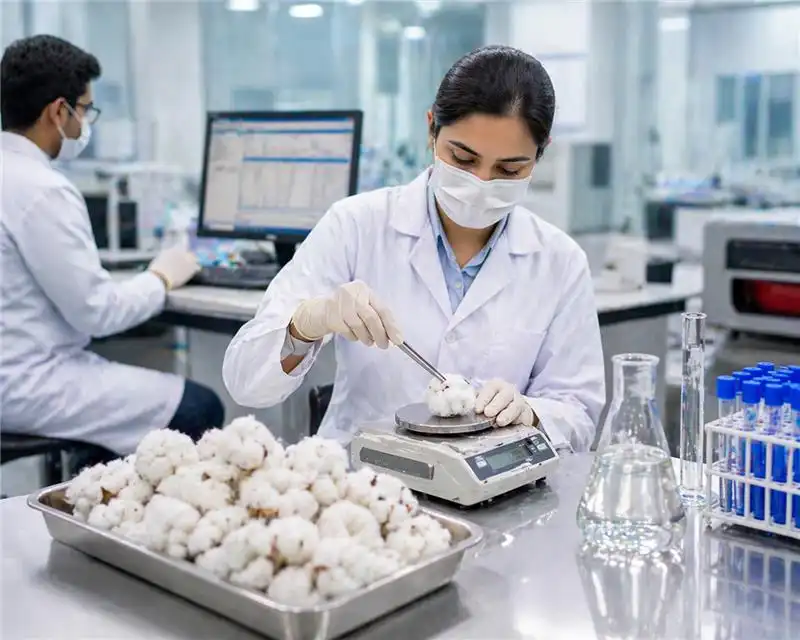
Most fabric rejections don’t start at the loom. They start with raw cotton that nobody has tested properly. A bale looks fine, the supplier says it’s consistent, and production moves forward on that assumption, until it doesn’t.
Cotton varies batch to batch more than most buyers expect. Moisture shifts. Contamination sneaks in. Fibre quality dips without warning. None of these announce themselves until they’ve already caused a problem somewhere down the line.
Working with a reliable cotton testing lab is how manufacturers stop that pattern before it starts. Most quality issues don’t begin in spinning or weaving; they begin with raw cotton that hasn’t been properly tested.
Here’s how a structured testing process should be done.
Why Every Manufacturer Needs a Cotton Testing Lab
Fabric rejections are expensive, but most are preventable. The issue usually isn’t production—it’s untested or poorly tested cotton. Here’s a step-by-step process to ensure cotton is properly tested before it enters production.
Step 1: Get Sampling Right
Testing is only as good as the sample that goes into it. Most manufacturers know this in theory — fewer apply it consistently in practice.
Pulling cotton from one bale and treating it as the whole picture is one of the most common mistakes in the process. Lot variability is real, and a single grab doesn’t capture it. A reliable inspection company or analytical testing laboratory samples across multiple bales, makes sure the full range of variability in the lot is represented, and keeps handling clean so contamination doesn’t skew the results before testing even begins.
The most capable analytical testing services can’t fix a bad sample. Get this step right and everything downstream becomes more reliable.
Step 2: Start With Manual Cotton Classing
Before any instrument touches the cotton, a trained eye should. Manual cotton classing is the process of physically grading cotton for colour, trash content, leaf matter, and preparation — the things that tell you whether a lot is what the supplier says it is.
Manual cotton testing at this stage isn’t old-fashioned. It’s still one of the most reliable ways to catch lot-level inconsistencies that automated systems can miss, especially when you’re sourcing from multiple suppliers with varying quality controls. A proper manual cotton testing lab will grade against recognised standards and give you a written assessment you can hold a supplier accountable to.
If the cotton doesn’t pass classing, nothing downstream matters. This is where the filter starts.
Step 3: Test the Moisture — Every Single Time
Moisture causes more problems than most manufacturers want to admit. Cotton sitting at the wrong moisture level behaves differently in every stage of processing — it spins poorly, weighs inconsistently, and creates conditions for microbial growth during storage and transit.
Cotton moisture testing isn’t complicated, but it has to be done right. Field checks with handheld meters give you a rough reading. What a dedicated cotton moisture testing lab gives you is a calibrated, reproducible result that you can actually rely on when something goes wrong, and a buyer asks for documentation.
The acceptable moisture range for most cotton is narrow. Anything outside it should be flagged before the lot moves anywhere.
Step 4: Run a Full HVI Test
High-volume instrument testing is where you get the numbers that actually drive production decisions. Fibre length, length uniformity, strength, micronaire, and elongation — these aren’t just quality metrics. They determine what the cotton can and can’t do in spinning.
A cotton testing laboratory running a proper HVI test gives you a fibre profile that helps you match raw material to end product. If you’re producing fine count yarn for a premium buyer, you need cotton that the HVI confirms can handle it. If you’re blending from multiple lots, the HVI results tell you how to mix them without creating consistency problems in the finished yarn.
Most rejections at the yarn or fabric stage can be traced to a fibre property that wasn’t checked. HVI testing is how you close that gap.
Step 5: Don’t Skip the Chemical Test for Cotton
Physical and mechanical testing tells you a lot. It doesn’t tell you what’s in the cotton chemically, and that matters more than it used to.
A chemical test for cotton screens for pesticide residues, pH levels, formaldehyde content, heavy metals, and finishing agents that can cause problems either in processing or in the finished product. Export buyers, particularly in Europe and parts of Asia, now require chemical test documentation as a standard part of the purchasing process. Some won’t accept a shipment without it.
Working with an analytical testing laboratory that runs a full chemical panel means you have the documentation ready before it’s requested, rather than scrambling to produce it after a shipment is held up. This is one area where skimping on analytical testing services consistently comes back to bite manufacturers at the worst possible moment.
Step 6: Check for Contamination
Contamination is quiet until it isn’t. A small amount of polypropylene, synthetic fibre, or other foreign matter in a cotton lot can create visible defects in finished fabric that no post-processing can correct. By the time those defects show up in fabric, the contaminated cotton has already moved through the entire production line.
A thorough analytical testing lab checks contamination levels through a combination of manual sorting and instrumental analysis. The output is a contamination profile, something manufacturers can use to make an informed decision about whether a lot is suitable for the end application it’s intended for or needs to be redirected elsewhere.
This step is non-negotiable for anyone supplying to buyers with strict quality thresholds.
Step 7: Pre-Shipment Inspection Before Anything Leaves
Cotton Testing Lab results confirm what the cotton is. Pre-shipment inspection confirms that what’s being shipped matches what was tested.
An experienced inspection company cross-checks the lot against purchase order specifications, verifies packaging and labelling, and provides an independent record of what is left at the facility. If a buyer later raises a dispute, that inspection report is what you point to.
This isn’t about covering yourself — it’s about closing the loop on a testing process that only works if it’s complete. Manufacturers who skip this step are essentially assuming nothing changed between the lab test and the loading dock. That’s an assumption that occasionally turns expensive.
Putting It All Together
Most fabric rejections are predictable. The cotton that causes them usually had warning signs that proper testing would have caught early. A consistent process — sampling, moisture testing, HVI, chemical screening, contamination checks, and pre-shipment inspection removes the guesswork that makes quality control reactive instead of proactive.
That’s where Qualitek Labs comes in. As a trusted cotton testing laboratory in India, Qualitek Labs handles everything from manual cotton classing and cotton moisture testing to chemical testing and full analytical testing services — under one roof, with accuracy and turnaround that match real production timelines.
For manufacturers who want quality locked in before production — not chased after a rejection — Qualitek Labs is the right partner.
FAQs
Why is a cotton testing lab important for manufacturers?
A cotton testing lab helps manufacturers detect moisture issues, contamination, and inconsistent fiber quality before production, reducing fabric rejections and ensuring better control over spinning, weaving, and overall textile performance.
What tests are performed in a Cotton Testing Laboratory?
A Cotton Testing Laboratory performs manual cotton testing, cotton moisture testing, chemical testing for cotton, and analytical testing to evaluate fiber strength, contamination, and overall suitability for consistent textile manufacturing.
What is manual cotton testing?
Manual cotton testing involves checking fiber length, color, and visible contamination. It helps manufacturers quickly identify quality issues before advanced analytical testing, reducing the risk of processing defects and inconsistent fabric output.
How does cotton moisture testing affect fabric quality?
Cotton moisture testing ensures fibers have the correct moisture level, preventing yarn breakage, strength variation, and processing inefficiencies that can lead to defects and higher fabric rejection rates during textile production.
What does a cotton moisture testing lab do?
A cotton moisture testing lab measures moisture content in cotton bales using calibrated instruments, helping manufacturers avoid overweight material, brittleness, and storage issues that can impact fiber performance and final fabric quality.
Why is a chemical test for cotton necessary?
A chemical test for cotton detects residues like pesticides and heavy metals that can interfere with dyeing and finishing, ensuring compliance with quality standards and reducing the risk of defects in final fabric output.
How does an analytical testing lab reduce fabric rejection?
An analytical testing lab provides accurate data on fiber strength, fineness, and contamination, helping manufacturers select the right cotton batches and maintain consistency, ultimately reducing defects and fabric rejection rates.
What are analytical testing services for cotton?
Analytical testing services include fiber analysis, contamination detection, moisture testing, and chemical evaluation, helping manufacturers ensure cotton meets required quality standards before entering the production process.